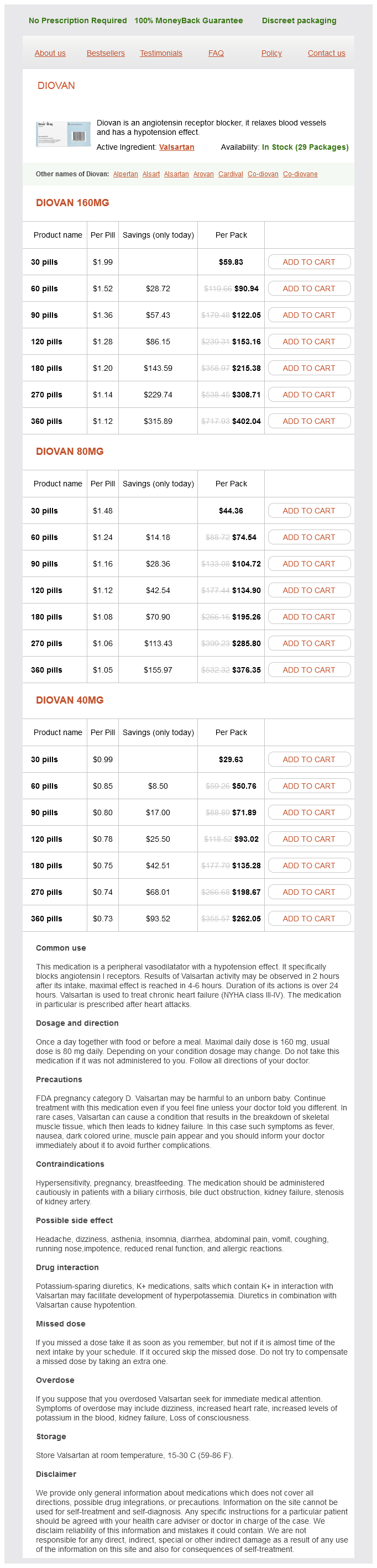
Diovan 160mg
- 30 pills - $59.83
- 60 pills - $90.94
- 90 pills - $122.05
- 120 pills - $153.16
- 180 pills - $215.38
- 270 pills - $308.71
- 360 pills - $402.04
Diovan 80mg
- 30 pills - $44.36
- 60 pills - $74.54
- 90 pills - $104.72
- 120 pills - $134.90
- 180 pills - $195.26
- 270 pills - $285.80
- 360 pills - $376.35
Diovan 40mg
- 30 pills - $29.63
- 60 pills - $50.76
- 90 pills - $71.89
- 120 pills - $93.02
- 180 pills - $135.28
- 270 pills - $198.67
- 360 pills - $262.05
Diovan dosages: 160 mg, 80 mg, 40 mg
Diovan packs: 30 pills, 60 pills, 90 pills, 120 pills, 180 pills, 270 pills, 360 pills
In stock: 844
Only $0,77 per item
Description
It is of observe that the aberrant right subclavian artery is only hardly ever related to airway or esophageal signs blood pressure medication recall diovan 80 mg otc. An anterior esophageal indentation is sort of at all times caused by distal origin of the left pulmonary artery hypertension means 80 mg diovan fast delivery, ensuing in this vessel coursing between the trachea and esophagus and causing a pulmonary artery sling blood pressure and diabetes purchase 40 mg diovan with mastercard. Hyperinflation seen on the chest x-ray film is a attribute discovering in infants with a large left-to-right shunt related to pulmonary hypertension arrhythmia jantung 80 mg diovan purchase amex. A and B, Note that the location of the stenosis may be noticed at the heart of the "three" sign fashioned by the prestenotic and poststenotic dilation of the aorta on this attribute radiograph in a 5-year-old baby. Note the dilation of the ascending aorta, which is the one radiographic sign up kids. Note the anterior rounded indentation in the barium-filled esophagus and the posterior bulge into the air-filled trachea anteriorly. B, Lateral view: Note the anterior rounded indentation within the barium-filled esophagus and the posterior bulge into the air-filled trachea anteriorly. The flattened hemidiaphragms are clearly seen on the lateral projection, a finding predictive of related pulmonary hypertension. It ought to be cautioned that the interpretation of pulmonary vascularity may be quite troublesome and should all the time be interpreted throughout the context of other medical findings. Oligemic lung fields indicate decreased pulmonary blood move, as seen in most kinds of cyanotic congenital coronary heart disease, the classic instance being tetralogy of Fallot. SkeletalAbnormalities Attention must also be given to the thoracic cage together with the backbone and ribs. Rib notching is a distinct radiographic finding in older sufferers with coarctation of the aorta. Scoliosis is a typical discovering in teenage patients with cyanotic congenital heart illness. Note the radiographic findings of extreme pulmonary venous obstruction and pulmonary edema, mimicking respiratory distress syndrome or another primary pulmonary pathology. Note the left axis deviation, left atrial enlargement, and left ventricular hypertrophy. Because of its affiliation with chest wall and spine abnormalities, mitral valve prolapse (and associated connective tissue problems, similar to Marfan syndrome) should be thought of in this context. The presence of a superior axis (180 to 270, or zero to -90 degrees) suggests certain specific cardiac defects. Being sure about hypertrophy within the pediatric age group is difficult due to the wide selection of regular values that fluctuate with age. This is especially true of right ventricular hypertrophy, which could be a physiologic finding in the first several years of life. On the opposite hand, left ventricular predominance in the newborn is kind of always a pathologic finding and normally signifies one of many hypoplastic proper heart syndromes, such as tricuspid atresia (left ventricular predominance is shown in. An outline of those problems primarily based on the need for therapy is introduced in Table 5. For the quite a few rhythm disorders not listed, administration have to be individualized, taking into account the presence or absence of related coronary heart illness. Transient arrhythmias may present within the following method: an asymptomatic youngster with an irregular heartbeat noted on examination, palpitations, chest ache (a common criticism amongst youngsters youthful than 10 years old once they sense a tachycardia), dizziness or pre-syncope, or precise syncope with or with out seizure activity. More sustained arrhythmias might result in congestive coronary heart failure, cardiogenic shock, or even death. The most typical irregularity of heart rhythm seen in kids is a sinus arrhythmia. This is a traditional variant that reflects a healthy interaction between autonomic respiratory and cardiac management exercise within the central nervous system. Typically the heart price will increase throughout inspiration and reduces throughout expiration and may sound wildly irregular on auscultation unless cautious attention is paid to the relationship between the heart price and respirations. Another regular variant occurs when the atrial pacemaker transiently shifts from the sinus node to another atrial site with only minimal variation within the heart price. Premature atrial contractions are generally benign after they happen in the absence of underlying heart disease. An exacerbation of the arrhythmia with this maneuver would warrant immediate cardiologic investigation; suppression of untimely ventricular beats with train could be reassuring. Note the variable morphology of the P wave, indicating origin from either the sinus node (upward arrows) or an ectopic atrial site (downward arrows). The most frequent age of presentation is within the first 3 months of life, with secondary peaks occurring at eight to 10 years old and again throughout adolescence. In a child younger than 1 yr old the sinus fee could reach 220 to 250 beats/minute in periods of severe stress, similar to sepsis, dehydration, or high fever. The abnormal pathway could be precisely mapped during an electrophysiology examine, and utility of radiofrequency energy or cryoablation on the acceptable website can lead to quick disappearance of the delta wave in a affected person with Wolff-Parkinson-White syndrome. When the arrhythmia substrate is in proximity to the atrioventricular node (atrioventricular node re-entry or septal accessory pathways), cryoablation supplies a bigger safety margin than radiofrequency ablation due to the reversibility of cryoablation lesions terminated on the first signal of atrioventricular nodal damage. Sustained ventricular tachycardia is distinctly uncommon in childhood, and the affected person have to be totally investigated for underlying heart illness. This arrhythmia is most often related to hemodynamic compromise and is characterized by a daily wide-complex tachycardia, often with atrioventricular dissociation if P waves are visible. One situation that needs to be acknowledged is congenital third-degree atrioventricular block. This might happen with associated structural coronary heart disease, nevertheless it happens more regularly with an otherwise normal coronary heart. The presence of maternal connective tissue disease or antinuclear antibodies ought to always be sought as a potential trigger when congenital atrioventricular block is detected in a newborn. Acquired third-degree block within the pediatric population could also be because of surgical injury to the conduction system during restore of complex cardiac anomalies, myocarditis, Lyme disease, acute rheumatic fever, or sicknesses associated with vasculitis. The Q-T interval must be corrected for coronary heart fee by using the Bazett formula: measured Q-T interval (0. Echocardiography Echocardiography with Doppler interrogation first provided remarkable advances in the investigation of congenital heart defects within the early Nineteen Eighties and is now the usual imaging modality for the prognosis of congenital coronary heart disease. Echocardiographic imaging and shade circulate Doppler enable correct anatomic definition of even complicated congenital defects, in addition to offering a dependable noninvasive hemodynamic evaluation of the patient. These instruments complement and, in most cases, replace the need for diagnostic cardiac catheterization and angiography in the management of patients with congenital heart illness. Accurate diagnosis of most structural congenital coronary heart illnesses, whether or not simple or advanced, can be made by echocardiography. A systematic strategy to outline main intracardiac connections is a useful starting point: (1) venoatrial (systemic or pulmonary venous return to the best or left atrium), (2) atrioventricular (atria to the ventricles), and (3) ventriculoarterial (ventricle to the nice vessels). The most common sort is the secundum defect, which involves the middle portion of the atrial septum in the region of the fossa ovalis. Both kinds of sinus venosus atrial septal defects are related to partial anomalous pulmonary venous return of a number of right pulmonary veins. An ostium primum defect known as a partial form of an atrioventricular septal defect is seen in. The complete type of an atrioventricular septal defect consists of a big defect within the middle of the guts, in affiliation with a common atrioventricular valve. Ventricular septal defects are properly defined by echocardiography and are often seen clearly using the apical four-chamber view. The commonest defect is in the perimembranous septum positioned within the subaortic area and bordered by the tricuspid valve. Moderate defects in the muscular portion of septum are simply visualized in a quantity of views. Although small defects located in the muscular septum can be tough to picture, particularly if located in the apical trabecular area, they can be readily detected by color flow Doppler interrogation. Typical findings in the most typical cyanotic heart lesion, tetralogy of Fallot, are a dilated aortic root that overrides the ventricular septum, a large perimembranous ventricular septal defect, and right ventricular outflow obstruction. Truncus arteriosus is a associated conotruncal anomaly associated with a large ventricular defect and a typical arterial trunk (truncus) arising from each the proper and left ventricles, with the pulmonary arteries arising directly from this vessel just above the semilunar valve. Transposition of the nice arteries, one of the common cyanotic defects to present within the newborn period, is associated with extreme cyanosis instantly after start and may be acknowledged by the attribute discovering of parallel takeoff of the nice vessels from each ventricles, with the aorta arising anteriorly from the best ventricle and the pulmonary artery originating posteriorly from the left ventricle. Note the large defect within the fossa ovalis area (asterisk) on the subcostal view (left). Note the defect (arrow) on the apical four-chamber view (left) in the inferior portion of the atrial septum. C and D, Systolic frames demonstrate atrial (yellow asterisk) and ventricular (green asterisk) parts of the defect (C). Note that the defect (arrow) is situated within the superior portion of the septum as seen on the apical four-chambered view (left).
Indian Asparagus (Asparagus Racemosus). Diovan.
- Are there safety concerns?
- What is Asparagus Racemosus?
- Dosing considerations for Asparagus Racemosus.
- Are there any interactions with medications?
- Pain, anxiety, stomach and uterine spasms, breast milk stimulation, uterine bleeding, premenstrual syndrome, alcohol withdrawal, indigestion, gastric ulcers, diarrhea, bronchitis, diabetes, dementia, and other conditions.
- How does Asparagus Racemosus work?
Source: http://www.rxlist.com/script/main/art.asp?articlekey=97111
Increase in nephrology advanced trainee numbers in Australia and associated discount in medical publicity over the past decade heart attack 45 years old diovan 40 mg discount amex. Teaching pediatric residents about studying issues: use of standardized case dialogue versus multimedia laptop tutorial blood pressure chart athlete 160 mg diovan purchase amex. Adapting web-based instruction to residents information improves studying efficiencies blood pressure on apple watch 160 mg diovan purchase overnight delivery. Instructional design variations in internet-based studying for well being professions schooling: a scientific evaluation and meta-analysis hypertension questionnaire order 40 mg diovan with amex. Development and evaluation of a multimedia e-learning useful resource for electrolyte and acid-base problems. Kidney stones � a global image of prevalence, incidence and associated danger elements. The epidemiology, diagnosis and management of aristolochic acid nephropathy: a story evaluate. Specialty Training Curriculum for Renal Medicine August 2010 (Amendments August 2012). Tropical distal renal tubular acidosis: medical and epidemiological studies in 78 patients. The persistent kidney illness epidemic: a problem for nephrology coaching packages. Updated programme for harmonization of coaching in nephrology within the European Union. Our knowledge base is gleaned from the cautious observations of master clinicians and scientists who acknowledged medical traits and patterns of malformation in people with genetic, teratogenic, developmental, and metabolic problems. They have supplied us with a framework for the investigation of patients from scientific and laboratory perspectives. In addition to classic cytogenetics, molecular cytogenetics methods have been more and more integrated in scientific settings and have tremendously assisted analysis, enabling far higher understanding of the molecular and physiologic foundation of these problems, and have tremendously increased the rate of prognosis of kids with genetic and metabolic issues. However, even with the supply of an ever-widening array of confirmatory exams, scientific evaluation of sufferers remains a very important part of the complete evaluation of youngsters and adults with genetic illnesses and dysmorphic situations. This stems from the truth that careful analysis can substantially cut back the number of differential diagnostic potentialities and, thereby, the number of diagnostic exams and the entire expense. Visual identification of dysmorphic features, baseline anthropometrics mixed with serial measurements with recognition of patterns of malformation and behavioral phenotypes, stays an integral part of the diagnostic algorithm. As in pediatrics in general, genetic problems must be investigated on the basis of a cautious historical past, with a family pedigree and a thorough physical examination together with evaluation for the presence of major and minor anomalies, and considerate laboratory testing. This chapter is designed to present clinicians who care for children with background on the final rules of genetics and dysmorphology, in addition to up to date details about necessary advances in our area. Although not exhaustive, it supplies a framework for the broad categories of genetic diseases and discusses an strategy to the analysis of the dysmorphic youngster. Definitions and examples of the kinds of problems resulting in genetic and/or congenital anomalies in youngsters are described, together with malformations, deformations, disruptions, associations, and sequences. We include examples of issues inherited via traditional mendelian inheritance patterns, including single-gene mutations, corresponding to Marfan syndrome, Rett syndrome, Smith-Lemli-Opitz syndrome, and Conradi-H�nermann syndrome, in addition to examples of nonmendelian disorders, similar to teratogenic exposures in utero and disruptions or deformations of previously normal fetal structures. However, you will want to introduce to the reader our present understanding of the subject material. Approximately 10% are genes that encode proteins which are assembled to type tissue buildings or to type enzymes that catalyze chemical reactions within cells. The other 90% have features which would possibly be currently not clear (see additionally the Nature of Genes and Single-gene Disorders, later). The members of every pair of genes are called alleles, and the members of each pair of chromosomes are often known as homologues. Except for gametes, regular human cells include 23 pairs of chromosomes, 46 in all. One of these pairs is anxious partially with inducing the primary sex of the embryonic gonads. The remaining 22 pairs are known as autosomes, they usually determine non� sex-related (somatic) characteristics. The in vitro life cycle and the cellular division, or mitosis, of a somatic cell are illustrated in. Any somatic cell that may divide in tissue culture can be utilized for chromosomal (cytogenetic) analyses. The most handy tissue supply is peripheral blood, from which lymphocytes may be stimulated to divide during 2 or 3 days of incubation in tissue tradition medium. After dying, lung tissue is the most effective tissue to tradition for chromosomal analyses, although the process additionally requires a 4- to 6-week incubation period. Alternatively, pores and skin fibroblasts are regularly obtained postmortem for various enzymatic and cytogenetic analyses, which may be used to confirm a scientific prognosis. When a treatment choice requires urgency, preliminary chromosomal analysis can 2p 1p 3 be made inside four to 24 hours through the use of uncultured bone marrow aspirate. This is applied in the clinical setting and is being beneficial as step one in the investigation of patients with developmental delays, mental retardation, and a number of congenital anomalies. This is an ever-evolving area, and pediatric clinicians are advised to talk about clinical and laboratory investigations with clinical geneticists and/or laboratory directors before the initiation of tissue sampling to guarantee the most efficient use of samples and speedy testing strategies. Aneuploidy Aneuploidy refers to an abnormality in chromosome number, in humans a chromosome number different from an even a quantity of of 23 (the haploid number). C, Metaphase: forty six duplicated chromosomes align randomly on the spindle and could be photographed for karyotyping. D, Anaphase: Chromosomes divide longitudinally, and half of each one strikes to the opposite pole of the cell. Note the extra chromosome 13, inflicting the cell to have 47 as a substitute of 46 chromosomes. Rarely, multiples of the X or Y chromosome end in people with forty eight or 49 chromosomes. Double aneuploidy, the simultaneous incidence of two nondisjunctional occasions, has been described in the literature. Double autosomal trisomy has been found repeatedly in spontaneous abortion however has not been demonstrated in a liveborn infant. If aneuploidy happens in a gamete as a outcome of an error of chromosomal division (nondisjunction or anaphase lag) during meiosis, all cells are affected within the fertilized embryo. With subsequent pregnancies, the risk for another chromosomal abnormality in the offspring is increased approximately 1% to 2% total, along with the overall background danger of abnormalities. The couple would be at risk for aneuploidy states of many varieties, not simply the particular aneuploidy in their affected child. Mosaic Aneuploidy States Mosaicism, the presence of two or extra genetically totally different cell strains within a person, may finish up from an error in division during either meiosis or mitosis. In different circumstances of mosaicism the one-celled embryo (zygote) is chromosomally normal and a division error occurs after fertilization, during mitosis of an embryonic somatic cell, leading to aneuploidy. Most individuals with mosaicism have only two or three different strains of embryonic cells. It requires appreciable laboratory investigation to distinguish the meiotic or mitotic sorts. Hypomelanosis of Ito is characterised by marbleized or mottled areas of hypopigmented whorls of pores and skin alongside the Blaschko strains and is of heterogeneous etiology. Individuals with hypomelanosis of Ito can have a number of congenital anomalies, dysmorphic options, variable mental retardation, and different neurologic findings. Karyotyping from pores and skin lesions will reveal mosaic abnormality of chromosomes from normal or hypopigmented and hyperpigmented regions. Abnormalities of Chromosome Structure Chromosomes could be normal in number (diploid) but nonetheless be abnormal in construction. About 1 in 520 normal people carries a balanced but structurally irregular set of chromosomes, referred to as a chromosome translocation. Note the up-slanted palpebral fissures (A), low-set ears (B), and unilateral simian crease (C). Triple X females are tall, and mosaic Down syndrome is just like full Down syndrome but with a much milder phenotype. The affected person died of multiple delivery defects and in essence had a partial trisomy of the distal portion of the q arm of chromosome 3. At 4 months of age characteristic streaks and whorls of hyperpigmentation and hypopigmentation of the skin have been noted. Data recommend that a small proportion of individuals with apparently "balanced" translocations are literally mildly affected clinically by variable levels of cognitive and physical deficits (Warburton, 1991). A frequent method during which households with apparently balanced chromosome translocations present for evaluation occurs when a child is born with structural malformations and on karyotyping is found to have an unbalanced chromosome translocation.
Specifications/Details
Acute renal colic: worth of unenhanced spiral computed tomography in contrast with intravenous urography blood pressure medication norvasc generic 40 mg diovan. Relationship between hydrocarbon exposure and nephropathlogy in main glomerulonephritis Nephrol Dial Tranplant blood pressure chart urdu diovan 40 mg cheap free shipping, 9 arterial network cheap 40 mg diovan fast delivery, 1575�9 arteria haemorrhoidalis media order diovan 160 mg visa. The condition is progressive: initially, the fibrous tissue is pretty mobile, later becoming comparatively acellular. The mechanism by which obstruction happens is probably due to loss of peristalsis due to the frequent remark that contrast medium injected into the decrease ureter may cross freely up to the pelvicalyceal system regardless of the presence of medical, radiological, and isotopic proof of practical urinary tract obstruction. The situation was first described within the French literature and the classic description got here from Ormond (1948). This inflammatory course of could cause weakening of aortic wall with medial thinning and promote atherosclerosis, and also extends into surrounding retroperitoneum with fibro-inflammatory reactions typical of continual periaortitis. Indeed, the autoimmune reaction to plaque antigens could possibly be an epiphenomenon of this immune-mediated process. Moreover, a quantity of infiltrating B cells present clonal or oligoclonal immunoglobulin heavy chain rearrangement. Familial clustering is rare with anecdotal instances in twins and siblings reported (Duffy et al. The most common cause is use of certain drugs particularly derivatives of ergot alkaloids-for instance, methysergide and the opposite ergot derivatives that affect the retroperitoneum, and also the pericardium, the pleura, and the lungs. Abnormalities demonstrated by laboratory checks embody some degree of renal insufficiency in as much as 75% of patients. Mild normochromic normocytic anaemia, elevated erythrocyte sedimentation fee and C-reactive protein are frequent, supporting the speculation that the illness process has an inflammatory nature. Leucocytosis, thrombocytosis, hypergammaglobulinaemia, antinuclear antibody, rheumatoid issue and perinuclear or cytoplasmic antineutrophil cytoplasmic antibody are less frequent. Moreover, vital proteinuria and/or macroscopic haematuria are infrequent findings (Vaglio et al. Perhaps for that reason bilateral rather than unilateral upper tract obstruction was present in the majority of patients. Ultrasonography, isotopic methods, and the intravenous urogram will reveal findings typical of urinary tract obstruction, and the latter may present medial deviation of the ureters. This final finding can also be present in regular topics and is an unreliable information to prognosis. Clinical features the clinical manifestations of this disorder differ with the stage of presentation. Early signs can consist of mild fever, weight loss, weak spot, nausea, vomiting, and malaise. The later stage of the disease is characterized by signs associated to the entrapment of the retroperitoneal construction, such as ureters (back and/or flank and/or stomach pain, haematuria, polyuria, oliguria, and anuria), renal arteries (renovascular hypertension), superior and inferior mesenteric vessels (bowel ischaemia), inferior vena cava (leg oedema and deep vein thrombosis), gonadal vessels (hydrocoele) and lymphatics, aorta, and common iliac arteries (lymphoedema, claudication, and barely gangrene). In as a lot as 15% of sufferers, the fibrotic course of can also involve buildings exterior the retroperitoneum, supporting the hypothesis that the illness has a systemic nature. Inflammatory myofibroblastic tumour presenting as pseudotumour impacts kids and has distinct histological characteristics with mainly myofibroblast proliferation. A histological diagnosis should be obtained if in any respect potential, and laparotomy is required so as to get hold of a sufficiently massive pattern to exclude lymphoma and cancer with confidence. In a current randomized managed trial after preliminary induction remedy with steroids, patients randomized to tamoxifen as upkeep therapy had the next price of relapse compared to when steroids only have been used as sole upkeep remedy (Vaglio et al. Another attainable approach is mixture therapy consisting of steroids together with other immunosuppressive agents such as mycophenolate, cyclophosphamide, methotrexate, or ciclosporin. Few anecdotal successes have been reported with combos with the expense and threat of elevated toxicity. Bilateral ureteral obstruction because of envelopment and compression by an inflammatory course of. Prednisone versus tamoxifen in sufferers with idiopathic retroperitoneal fibrosis: an open-label randomised managed trial. In the late phases, histology reveals pronounced sclerosis and scattered calcifications. Management of retroperitoneal fibrosis Management is empirical and controversial since managed trials of treatment are missing. The objective of any therapy consists of halting the development of fibrosis, relieving ureteric obstruction, suppressing acute section reactions, and stopping relapse. Corticosteroid therapy, with or without momentary aid of obstruction by insertion of ureteric stents, ureterolysis alone, and ureterolysis adopted by steroid therapy to shrink the periaortic mass and maintain remission have all been used. Corticosteroid remedy alone could right obstruction, but is on no account invariably efficient. Ureterolysis alone might appropriate obstruction in the long run but is usually associated with recurrence of obstruction or the event of obstruction in a previously unobstructed kidney. A reasonable policy for administration would appear to be to carry out unilateral or bilateral ureterolysis, as applicable, adopted by corticosteroid remedy in sufferers match for operation and capable of take steroids safely. Its estimated frequency is 1/40,000 kids and it was described as the underlying cause of deafness in 2% of children (Fraser et al. It is one of a quantity of circumstances inflicting renal failure with deafness (see Chapter 170). Branchial anomalies embody branchial cleft sinus tract or cysts and are found in every second patient. Townes�Brocks syndrome (see Chapter 359) is related to deafness and auricular abnormalities, however usually also different abnormalities that clearly differentiate it. The most common ear anomalies are preauricular pits in > 80% of circumstances, but all kinds of otologic findings has been described (Smith, 2009). They vary from mild (hydronephrosis, reflux) to extreme affection (agenesis, dysplasia) and could be uni- or bilateral and in some circumstances may proceed to end-stage renal failure or even intrauterine dying. Patients with renal dysplasia with out ear or branchial anomalies seem to be rare (Weber et al. The variability of medical symptoms is high amongst mutation carriers (Smith, 2009). Cervical investigations might embrace magnetic resonance imaging to detect typical cysts of the branchial arch. Renal imaging with ultrasound is requested to establish circumstances with renal anomalies and/or hypodysplasia. Treatment and outcome Branchial clefts or cysts might be treated by way of surgical excision. Familial branchio-oto-renal dysplasia: a brand new addition to the branchial arch syndromes. However, the variety of oligosymptomatic or undiagnosed cases is unknown as sufferers could evade the scientific prognosis till maturity (Faguer et al. Renal involvement is observed in 42% of circumstances, ranging from mild anomalies (including vesicoureteral reflux or horseshoe kidneys) to extreme useful impairment related to persistent or end-stage renal failure. The vast majority represents nonsense mutations but deletion mutations have also been reported. In 50% of sufferers, mutations occur de novo, presenting to the clinician as sporadic circumstances with thus far uneventful household historical past. Each of these signs is seen in > 80% of patients and the entire triad is found in two-thirds of cases (Kohlhase, 2007). Additional findings include renal involvement, congenital heart illness (Surka et al. Right kidney is shown with elevated echogenicity and reduced corticomedullary differentiation. The Townes-Brocks syndrome in Spain: the epidemiological aspects in a consecutive sequence of instances (article in Spanish). A thorough household history and a complete bodily examination with respect to minor abnormalities are mandatory in each neonatal case. Auditory testing, echocardiography, renal imaging with ultrasound, and X-ray of bone deformities provide further data. Renal and thyroid operate checks must be carried out in each case as congenital hypothyroidism could be current in uncommon circumstances. Prenatal diagnosis, based on genetic testing and ultrasound examination, is feasible, especially in families with a recognized mutation. An imperforate anus has to be operated on early after delivery by an experienced paediatric surgeon, cardiac defects ought to be handled as recommended. A hearing deficit ought to be recognized early and treated with hearing aids when needed. Renal perform ought to be monitored into adulthood and renal impairment has to be treated with supportive standard remedy.
Syndromes
- Liver biopsy
- 6 hours: 3 - 16%
- You would describe your headache as "your worst ever," even if you regularly get headaches
- Calamine lotion for stings or poison ivy
- Avoids physical contact
- Endoscopy -- camera down the throat to see burns in the esophagus and the stomach
Related Products
Additional information:
This diverticulum predisposes to stone formation and should thus be revealed by haematuria or pain blood pressure monitor walgreens order diovan 160 mg on-line. A distinctive multilocular cyst with septa blood pressure medication protocol order 40 mg diovan amex, not linked to the pyelocalyceal system arteria revista 40 mg diovan for sale, ought to evoke the prognosis of multilocular cystic nephroma blood pressure numbers what do they mean buy diovan 80 mg, which is a very uncommon, benign neoplasm. Chronic potassium depletion such as in major aldosteronism may induce the development of kidney cysts, predominantly within the medulla (Torres et al. Renal cysts noticed in primary distal tubular acidosis may be explained by hypokalaemia (Torres et al. This situation is due to the larval type of the cestode Echinococcus, transmitted by contact with contaminated animals. Typical imaging aspect is a large calcified cystic lesion containing daughter cysts. Sensitivity of the checks used for serum anti-Echinococcus antibody detection is in the range of 50�80%. Those in (past and current) close contact with canine in a recognized endemic area are significantly in danger (Huang and Zheng, 2012). Associated dysplastic kidney abnormalities and extrarenal features normally reveal the primary condition (see Chapter 313), whereas kidney angiomyolipomas usually coexist with cysts in the second (see Chapter 330). The illness is both sporadic or familial Multiple cysts, bilaterally, in regular or small-sized kidneys All hereditary issues listed in Table 304. Multiple, bilateral cysts with normal-sized kidneys may also be present in medullary sponge kidney (see Chapter 319), acquired. Clinical and demographic traits of patients with urinary tract hydatid illness. Hepatocyte nuclear factor-1 beta: a brand new kindred with renal cysts and diabetes and gene expression in regular human improvement. Association between easy renal cysts and development of hypertension in wholesome middle-aged men. An ultrasound renal cyst prevalence survey: specificity information for inherited renal cystic illnesses. Multilocular cystic renal cell carcinoma: a report of 45 cases of a kidney tumor of low malignant potential. The cysts can regress after profitable kidney transplantation, however conversely can develop in chronically rejected kidneys. The most severely affected youngsters incessantly die shortly after start as a result of pulmonary hypoplasia. Cystic kidney dysplasia and congenital anomalies of the kidneys and urinary tract Cystic dysplasia (see Chapter 345) is a typical finding in youngsters. Due to early embryonic maldevelopment, most instances are recognized by prenatal ultrasound within the first or early second trimester. Most essential is the analysis of extra options which may indicate a syndromic manifestation (Table 305. In some of these instances numeric or structural chromosomal abnormalities may be discovered. Renal dysplastic elements may be present in plenty of syndromes such as Bardet�Biedl or Meckel�Gruber syndrome (Bergmann, 2012) (see Chapter 314). While sometimes difficult, ultrasonographic differentiation from polycystic kidney illness is normally attainable. Incomplete penetrance or no much less than important variable expressivity and a excessive fraction of recent mutations have all the time to be stored in thoughts when evaluating the household history. About 2% of all sufferers present with an early manifestation in childhood, typically manifesting prenatally as Potter sequence as a outcome of extreme oligo- or anhydramnios. The clinical picture can be extremely variable even inside the same household and among patients carrying the same mutation. In some people with an early and severe illness manifestation, further hypomorphic alleles in trans have been found in genes for cystic kidney ailments and other ciliopathies. Autosomal recessive polycystic kidney illness this uncommon condition is described in Chapter 313. Typical ultrasonographic manifestations in childhood are massively enlarged kidneys with increased echogenicity. In rare cases congenital hepatic fibrosis Mitral valve prolapse, berry aneurysms, cystic pancreas Onset normally 3rd�5th decade, typically in kids, very rare in newborns with respiratory distress and renal insufficiency. Pain and enlargement of kidneys, proteinuria, haematuria, hypertension, nephrolithiasis, urinary tract an infection, cerebral haemorrhage 50%; increased recurrence danger for early manifestation after one affected youngster with early onset (in rare circumstances of spontaneous mutation no risk) Associated options Main scientific manifestations As part of syndromes involvement of different organs Variable: latent (unilateral involvement) or Potter sequence. Discordant sib pairs well-known No alterations Demonstration of one affected parent (unless dad and mom are too younger to reveal cystic modifications in ultrasound). Loss of the power to concentrate urine correctly causes early polyuria and polydipsia. Disturbances of electrolytes, anaemia, and metabolic acidosis are additional attribute findings. The diagnosis is normally made by imaging methods sometimes demonstrating normal-sized or hypoplastic kidneys with elevated echogenicity and no or corticomedullary-localized cysts. The weight of the road and arrow (from dotted to strong and bold) pointing to ultimate genetic diagnosis signifies the chance of causation. Cystic kidneys as an essential function of syndromes Cystic kidneys may happen as a manifestation of many genetic syndromes. An overview of a few of the most common syndromes with cystic kidney illness is given in Table 305. Most of those syndromes comply with an autosomal recessive mode of inheritance, however, some are autosomal dominantly or hardly ever X-linked inherited. Another trigger Non-heritable cystic kidneys/renal cysts as differential diagnosis Solitary cysts Solitary cysts have to be considered as a differential analysis of inherited circumstances. For bilateral cysts the respective figures are as follows: 1% (30�49 years), 4% (50�69 years), and 9% (> 70 years). Polycystic kidney illness in 2011: connecting the dots towards a polycystic kidney illness remedy. At an earlier stage, some may experience haematuria, ache from cyst haemorrhage, and an infection, which may be sluggish to resolve (see Chapter 307). Massive liver involvement typically causes signs but not often liver dysfunction, and is much extra likely to occur in girls than in men. Until recently, look after affected people was supportive and geared toward lowering cardiovascular morbidity and mortality, offering good blood strain management and symptomatic relief of disease issues, and renal alternative remedy when necessary. Key to facilitating this shift from translational research to translational medication has been the identification of well-validated medical trial endpoints that can be measured in a patient- and clinical trial-relevant time-frame. Mutation testing, in addition to guiding prognosis, may also be utilized in pre-symptomatic testing and diagnosis. With the wider availability of mutation testing with a clinically helpful mutation detection rate of > 70%, further indications are more likely to become obvious (see Chapter 308). Descriptions of bilateral enlarged cystic kidneys were made as early because the sixteenth century, but a scientific evaluation of the scientific options was first performed by Dalgaard in 1957. Development of bilateral enlarged kidneys was acknowledged to precede the onset of uraemia, typically by some years (Dalgaard, 1957). Other elements associated with more fast increase in kidney volume are higher urine sodium excretion, decrease serum high-density lipoprotein ldl cholesterol and lower renal blood circulate (Torres et al. Hyperfiltration at functioning nephrons initially maintains regular excretory operate despite the progressive progress of cysts and lack of normal parenchyma. Impairment of maximal urinary concentrating capacity is an early function, current in 60% of kids and accompanied by elevated vasopressin levels (Torres et al. Reduced renal blood flow and elevated renal vascular resistance are also early findings, which may result from activation of the renin�angiotensin system (Meijer et al. By the time excretory kidney function turns into considerably impaired, kidney volume is usually markedly enlarged, with little remaining regular parenchyma. Glomerular filtration price then declines quickly, at roughly 5 mL/min/year (Klahr et al. In addition to higher kidney dimension, threat elements for extra fast loss of kidney operate embrace hypertension earlier than age 35, male gender, gross haematuria earlier than age 30, a quantity of pregnancies, and black race (Johnson and Gabow, 1997). Cysts originate as saccular diverticulae from the tubule wall, which enlarge and lose continuity with the tubule lumen.
Usage: a.c.
Numerous problems of energy metabolism are described with their underlying pathology as insufficient availability of power to tissues blood pressure emergency diovan 80 mg free shipping. Thus arrhythmia list 40 mg diovan order otc, the tissues and organs most affected by mitochondrial dysfunction are those with excessive energy demands blood pressure medication val cheap diovan 160 mg mastercard, particularly neural arteria profunda brachii order diovan 80 mg amex, muscular, and ocular. A, the coarsening of facial options characteristic of this disorder includes prominence of the forehead, a flattened nasal bridge, a brief broad nostril, and widening of the lips. Disorders of major lactic acidosis often occur in the metabolism of pyruvate, the Krebs cycle, or during oxidative phosphorylation, and are sometimes referred to broadly as mitochondrial issues. The gene encoding this enzyme element is X-linked, but defects within the enzyme are commonly inherited in an autosomal dominant sample, and thus the number of affected girls with de novo mutations is sort of equal to the number of affected boys; feminine gender ought to subsequently not rule out this prognosis. Mitochondria are membrane-bound cytoplasmic organelles that, in essence, function the facility vegetation of cells. Thus most "mitochondrial" problems really comply with a mendelian sample of inheritance. Secondary lactic acidosis can be caused by tissue hypoxia secondary to use of a tourniquet or extreme crying, or from extended storage of room temperature blood samples in a Vacutainer. Secondary elevation of lactate from poor situations of specimen drawing or dealing with can result in invasive and unnecessary testing and procedures, and it might be averted by use of free-flowing or arterial specimens, avoiding multiple draw attempts, and speedy transport of the instantly iced specimen to the laboratory. The presence of elevated alanine indicated by plasma or serum amino acid analysis, and/or with mild to extreme keto-lactic acidosis, hyperammonemia, and different problems, and could be fatal in early life, or can present more chronically with intermittent keto-lactic acidosis throughout fasting. Infants with profound problems of pyruvate metabolism sometimes have nonspecific dysmorphic options, similar to a protracted philtrum and tented higher lip, most likely because of facial hypotonia. The presence of small to modest amounts of Krebs cycle intermediates on urine natural acid analysis can be normal within the first yr of life. The presence of large elevations or persistent excretion of Krebs cycle intermediates within the urine can sign a dysfunction of oxidative phosphorylation. It takes place within the mitochondria utilizing each nuclearly and mitochondrially encoded enzymes. Complex I consists of more than 40 different enzymes, of which seven are mitochondrially encoded. Nuclear Mutations Most mitochondrial issues are because of mutations in nuclearly encoded proteins and are inherited in a mendelian pattern. There are also some nuclear genes concerned in mitochondrial replication that lead to aberrant mitochondrial replication and/or mitochondrial depletion. Mitochondrial Point Mutations Mutations in the mitochondrial genome are additionally a reason for mitochondrial dysfunction and are maternally inherited. Note that whereas every cell accommodates just one nucleus housing two copies of the genome, each cell also incorporates multiple mitochondria, and each mitochondrion contains multiple copies of the mitochondrial genome; due to this, nuclear and mitochondrial inheritance patterns are completely different. Thus individuals can have a number of copies of each wild-type and mutated mitochondrial genomes coexisting in a single mitochondrion or in a single cell; this is identified as heteroplasmy. There is a threshold effect at which point the number of mutated mitochondria turns into adequate to have an effect on the operate of the cell, tissue, or organ. It is due to this fact potential for syndromic mitochondrial mutations to be maternally inherited in multiple relations, but symptomatic solely in these in whom the edge is reached. In children, they could follow a selected phenotype however can be multisystemic and fewer predictable. Other frequent mitochondrial syndromes associated with level mutations are listed in Table 1. Instead, they represent cell demise from vitality failure quite than blood flow abnormalities. Metabolic strokes can happen wherever in the mind, though the very best energy-requiring components of the mind (such because the basal ganglia) are common areas. Evaluation of a Patient With Suspected Mitochondrial Disease Traditionally, a affected person suspected of getting a mitochondrial illness undergoes biopsy of an apparently affected organ (typically muscle) for analysis of the oxidative phosphorylation complexes. However, the expanding availability of testing for mutations in nuclear and mitochondrial genes has created an evolving testing technique. In some cases, diagnosis may be reached on the premise of guided testing of blood samples, sparing sufferers an invasive biopsy. Failure to take in copper in the intestine results in systemic copper deficiency and impairment of copper-dependent mitochondrial enzymes. The dysfunction most commonly presents in infancy with loss of milestones, seizures, psychological retardation, tortuous cerebral arteries, sagging facial pores and skin, and weakened bones with fractures that may increase concern for child abuse until the correct diagnosis is made. Parenteral copper administered to presymptomatic boys might enhance outcome, however appears of minimal to no profit as soon as signs have developed. The number of subtypes is rising rapidly and will likely proceed to develop given the very massive number of genes involved in protein glycosylation. Typical options embrace abnormal fats pads on the pubis and over the buttocks, inverted nipples, strabismus, cerebellar atrophy, and failure to thrive. Fatal systemic disease including liver illness may be seen in some cases; others are inclined to develop ataxia and stroke-like episodes with age. Other subtypes can current with varying features together with protein-losing enteropathy, dysmorphic options, and various multisystem presentations. Diagnosis is achieved by noting an abnormal ferritin isoelectric focusing pattern (caused by abnormalities in posttranslational sialic acid residues), and updated testing is under growth. This disorder is likely underappreciated and ought to be thought-about in any case of multisystem genetic signs. Disorders of Sterol Metabolism A variety of problems are actually related to various defects within the biosynthesis of ldl cholesterol. Many of those had been first described as dysmorphic syndromes before the underlying biochemical abnormality was identified. The biochemical error is a block in the final step of cholesterol formation, with deficiency of cholesterol and accumulation of the precursor 7-dehydrocholesterol. Typical dysmorphic options embrace upturned nose, low-set ears, and attribute clenched arms. Affected patients usually have syndactyly of the second and third toes, and so they can have polydactyly, presumably a direct effect of the gene defect. Some phenotypic findings, similar to undervirilization of males, are attributable to cholesterol deficiency causing deficiency of cholesterol-based steroid hormones. There are a number of other disorders in different steps in cholesterol biosynthesis which have numerous bodily and developmental findings. Findings include chondrodysplasia punctata, uneven limb shortening, scoliosis, and scaly erythematous rash Other Inborn Errors of Metabolism A number of other inborn errors of metabolism have been identified. A alongside the strains of Blaschko in infancy that can become ichthyosis, scarring alopecia, and pigmentary abnormalities. As previously famous, infants with Zellweger syndrome typically have facial and tone traits suggestive of Down syndrome (although the hepatomegaly and other features are distinguishing). Chondrodysplasia punctata can have various metabolic causes, including peroxisomal (severe rhizomelic form with failure to thrive and systemic disease) or sterol (X-linked dominant chondrodysplasia punctata). Children with organic acidemias and youngsters with problems of power metabolism are sometimes reported to have "mitochondrial facies," together with nonspecific options presumably attributable to poor muscle tone, corresponding to midfacial hypotonia and prominent ears. Patients with quite so much of lysosomal storage diseases often are described as having "coarse" facial options, probably attributable to cellular accumulation of lysosomal materials. Newborn screening for common genetic and metabolic ailments has been revolutionized by the event of tandem mass spectrometry. B, Hypospadias, cryptorchidism, or ambiguous genitalia as proven right here may be seen. In the United States, new child screening is performed and regulated by the individual states, and some states now display for greater than 50 disorders. Disorders detectable by newborn screening embody inborn errors of metabolism, hemoglobinopathies, cystic fibrosis, acquired immune deficiency, severe mixed immunodeficiency, listening to loss, hypothyroidism, and congenital adrenal hyperplasia. This website supplies details about the issues and beneficial diag- nostic testing. The most recent additions to screening panels embrace lysosomal storage issues. The technical capacity to diagnose genetic and metabolic problems by new child screening has outpaced our understanding of the natural history and optimal treatment of a few of these issues. The committee developed a listing of major target problems based mostly on evidence-based guidelines, as well as an inventory of secondary issues, which are routinely detectable as part of the testing process for primary goal illnesses (Table 1.
Tags: purchase diovan 40 mg on line, purchase diovan 40 mg without prescription, 160 mg diovan discount visa, buy discount diovan 160 mg online, diovan 160 mg low cost, 80 mg diovan purchase amex, quality diovan 160 mg, discount diovan 40 mg on line, diovan 160 mg, diovan 160 mg buy online, diovan 80 mg discount without a prescription, diovan 160 mg discount with amex, 80 mg diovan generic free shipping, generic diovan 80 mg, diovan 40 mg cheap otc, purchase 80 mg diovan with amex
8 of 10
Votes: 291 votes
Total customer reviews: 291
Customer Reviews
Mazin, 54 years: Multiple mediators of nephron harm and fibrosis could operate, typically concurrently, and with various rates of development. The exterior orifice may be a small dimple or an simply visible opening surrounded by hair. This phenotype was first described in 1960 in a household with early-onset gout, hyperuricaemia, and renal disease (Duncan and Dixon, 1960). Therapy and follow-up needs to be individualized on the idea of the evaluation, related renal dysplasia, and extrarenal malformations.
Gunock, 37 years: Individuals are heterozygote for these mutations and within the absence of proteinuria or hypertension, this condition has been termed benign familial haematuria. The preliminary examine described two out of 14 youngsters reported who responded to immunosuppression (one on steroids, one on ciclosporin). Placenta Careful examination of the placenta can assist within the prognosis and remedy of many conditions and ailments. The differential analysis consists of practical and anatomic obstructions, infection, organomegaly, formulation intolerance, and much.