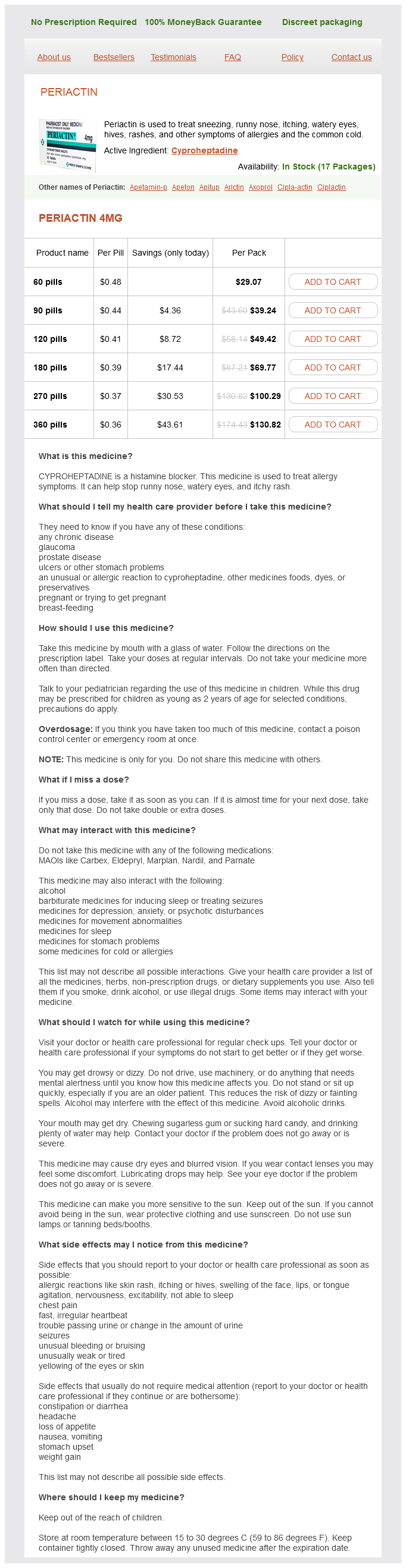
Periactin 4mg
- 60 pills - $29.07
- 90 pills - $39.24
- 120 pills - $49.42
- 180 pills - $69.77
- 270 pills - $100.29
- 360 pills - $130.82
Periactin dosages: 4 mg
Periactin packs: 60 pills, 90 pills, 120 pills, 180 pills, 270 pills, 360 pills
In stock: 849
Only $0,39 per item
Description
Not uncommonly allergy symptoms lose voice generic 4 mg periactin free shipping, a spasm of the exterior urethral sphincter will be encountered allergy medicine vs benadryl buy discount periactin 4 mg line, preventing filling of the posterior urethra allergy treatment to cats cheap periactin 4 mg with visa. If any distinction materials is seen throughout the bladder along side urethral extravasation allergy treatment immunotherapy 4 mg periactin buy with visa, a partial rather than a complete urethral disruption is more likely. In a complete urethral disruption, urethral extravasation shall be current without evidence of contrast throughout the bladder. As anticipated, penile venous intravasation (venous plexus opacification) will clear spontaneously on any postvoid movies, in contrast to urethral extravasation, which stays in place. If a Foley catheter has been successfully positioned into the bladder and a partial urethral injury is suspected later, such an harm could be readily demonstrated with out eradicating the catheter. Obtain a seal by compressing the glans penis with the nondominant thumb and index finger and gently inject distinction material with the dominant hand. It should be noted, however, that profitable placement of the Foley catheter obviates the need for additional treatment of a partial urethral tear in the emergency setting because an indwelling catheter alone is suitable initial management for this type of injury. Retrograde Cystogram As famous, demonstrate that the urethra is regular before passing the Foley catheter required for retrograde cystography. Then slowly inject 10 to 60 mL of a 10% resolution of contrast materials via the catheter lumen. Alternatively, use a plain-tipped (non�Luer-Lok) syringe or a cathetertipped (Toomey) syringe in the urethra. Squeeze the glans across the syringe to forestall spillage of the contrast material. Note that penis is pulled taut over the proximal a half of the thigh to prevent urethral folding. After injection of contrast material, the whole urethra could be visualized and inspected for harm. This might mimic urethral extravasation nevertheless it clears instantly, versus precise extravasation, which remains indefinitely. Extravasation distinction materials (arrow) is seen within the of distinction materials (white arrows) is seen corpus cavernosum. A lubricated pediatric feeding tube has been advanced into the urethra beside the indwelling Foley catheter. Next, fill the bladder under direct operator supervision by gravity instillation of distinction material. Pour the contrast materials into the syringe and allow it to fill the bladder by gravity instillation to one of three end points: (1) 100 mL with proof of gross extravasation on fluoroscopy or on plain film (if the examiner elects to examine at this point); (2) 400 mL in an adult or any baby aged 11 years or older. In children younger than eleven years, bladder capacity, and subsequently appropriate contrast volumes, are estimated based on this formula ([age in years + 2] � [30])99; or (3) the point of initiating a bladder contraction (see later), then add an extra 50 mL by hand injection underneath gentle however steady stress. Some authors advocate a dilute answer of distinction materials (10%) as a end result of extravasation into the periurethral or perivesical tissues may cause appreciable inflammatory reaction at higher concentrations. Retrograde cystography done by any technique aside from hand-poured gravity instillation is topic to inadequate bladder filling or connector tubing-catheter disconnection. It have to be careworn that within the absence of initial gross extravasation, the bladder should be crammed to 400 mL in an adult, or to an appropriate capability in a child, and the catheter clamped with a Kelly clamp. Volumes less than 400 mL have been related to false-negative findings, especially in penetrating bladder accidents. If this occurs, refill the bladder to the purpose of initiating a bladder contraction, clamp the Foley catheter, remove the initial syringe and exchange it with a 60-mL contrast-filled syringe, unclamp the catheter, hand-inject the extra 50 mL under pressure, and reclamp the catheter. Once the filled-bladder films have been obtained and reviewed, unclamp the Foley catheter and allow the distinction materials to drain into a bedside drainage bag. Extravasation from an injured bladder may be intraperitoneal, extraperitoneal, or both. It is essential to distinguish extraperitoneal from intraperitoneal damage as a end result of the remedy choices differ considerably: surgical restore is required for all intraperitoneal injuries and for those extraperitoneal injuries that extend into or primarily contain the bladder neck, especially in girls. Most different extraperitoneal injuries can be managed confidently by Foley catheter drainage alone. The bladder must be stuffed simply as if a conventional retrograde cystogram had been being obtained. When this is encountered, bladder damage with extravasation must be additional evaluated with selective photographs of the pelvis. Consult urology to assist in choice making in any case of urethral or bladder damage. Complications Contrast extravasation into periurethral or perivesical tissues in the case of urethral or bladder harm, respectively, might cause considerable inflammatory reaction, particularly distinction materials of upper concentrations. The normal bladder has a smooth outer contour and no extravasation of contrast materials is seen. Always carry out a postvoid film to assess for delicate posterior perforation, especially within the case of penetrating trauma. Abnormal Examinations 1 2 3 Extravasation Postvoid Extraperitoneal bladder perforation. The postvoid film demonstrates substantial posterior extravasation of contrast material. Extravasated contrast materials is seen surrounding the bladder (arrows) but no loops of bowel are outlined. Note the contrast materials outlining the paravesical house, tracking up the right paracolic gutter and outlying loops of bowel (arrows). No extravasation of contrast materials is seen, nonetheless, the pearshaped bladder indicates the presence of a pelvic hematoma. Above, extravasation of contrast material is noted adjoining to the left aspect of the bladder (arrow). Renal cortical lacerations greater than 1 cm in depth without urinary extravasation should be evaluated. For adult blunt trauma sufferers with gross hematuria or hypotension (systolic stress lower than ninety mm Hg), higher tract imaging is indicated. This laceration extends via the renal parenchyma and into the collecting system. Extravasation of distinction material is seen (long arrow), thus making this a grade four harm. This intraoperative excretory urogram reveals extravasation (arrow) within the upper a part of the proper ureter consequent to a stab wound. No distinction materials is seen within the ureter below the positioning of harm, a discovering indicative of complete transection. Delayed images revealed extravasation of contrast material from the distal finish of the ureter (arrow) into the fluid assortment. This delay permits the distinction materials to turn out to be concentrated within the kidneys and excreted through the ureters. Ureteral harm can then be identified by extravasation of distinction material into adjoining tissues. Cavusoglu yH, Karaman A, Karaman I, et al: Acute scrotum � etiology and management. Vijayaraghavan Sb: Sonographic differential diagnosis of acute scrotum: real-time whirlpool sign, a key signal of torsion. Kalfa N, Veyrac C, Lopez M, et al: Multicenter evaluation of ultrasound of the spermatic twine in kids with acute scrotum. Kalfa N, Veyrac C, baud C, et al: Ultrasonography of the spermatic cord in youngsters with testicular torsion: impact on the surgical strategy. Haecker F-M, Hauri-Hohl A, von Schweinitz D: Acute epididymitis in children: a 4-year retrospective research. Gray scale and shade Doppler sonographic findings in contrast with a standard appendix testis. Stehr M, boehm R, et al: Critical validation of colour Doppler ultrasound in diagnostics of acute scrotum in youngsters. Terai A, yoshimura K, Ichioka K, et al: Dynamic contrast-enhanced subtraction magnetic resonance imaging within the diagnostics of testicular torsion. Garel L, Dubois J, Azzie G, et al: Preoperative guide detorsion of the spermatic wire with Doppler ultrasound monitoring in patients with intravaginal testicular torsion. Kresling V, Schroeder D, Panljev P, et al: Spermatic twine block and manual discount: primary remedy for spermatic twine torsion.
Thyroid-suppressing Herbs (L-Carnitine). Periactin.
- Preventing side effects caused by valproic acid (Depacon, Depakene, Depakote, VPA), a seizure medication.
- Improving athletic ability.
- Eating disorders, fatigue, diabetes, high cholesterol, blood disorders, circulatory problems in the legs, leg ulcers, attention deficit-hyperactivity disorder (ADHD), Lyme disease, autism, Rett syndrome, and other conditions.
- Improving low birth weight.
- Symptoms of high thyroid hormone levels.
- Are there any interactions with medications?
- Treating male infertility caused by inflammation of some reproductive organs and tissues (prostate, seminal vesicles, and epididymis).
Source: http://www.rxlist.com/script/main/art.asp?articlekey=96985
Half of the calculated fluid requirement must be given within the first eight hours and the remaining half provided over the next sixteen hours (Box 38 allergy forecast vancouver wa periactin 4 mg cheap overnight delivery. Lastly allergy testing washington dc discount periactin 4 mg without a prescription, these fluid quantities are tips and urine output monitoring will assist in adjusting the speed or quantity to meet the target outputs of zero allergy treatment wiki periactin 4 mg order visa. The formulation estimate hourly fluid requirements and must be adjusted up or all the method down to allergy symptoms to msg 4 mg periactin generic free shipping achieve a urine output of zero. Insertion of a Foley catheter is normally essential to precisely measure hourly urine output. Patients uncovered to carbon monoxide ought to have carboxyhemoglobin ranges measured and empirically obtain 100% oxygen. The Cochrane evaluate of published trials found conflicting, doubtlessly biased, and customarily weak evidence relating to the usefulness of hyperbaric oxygen for the prevention of neurologic injury. Critically sick and pregnant sufferers are nonetheless often supplied hyperbaric therapy, however controversy over the efficacy and safety persists even for these subgroups. Patients suspected of getting been exposed to important levels of cyanide and manifesting signs ought to receive hydroxocobalamin (Cyanokit [Meridian Medical Technologies, Inc. If not available, the Cyanide Antidote Package may be used despite lack of confirmed advantage of this traditional cyanide remedy. It is reasonable to empirically administer hydroxocobalamin or the sodium thiosulfate portion of the cyanide kit to burn victims in coma or to these exhibiting metabolic (lactic) acidosis after smoke publicity. The Baux Score was developed a half-century ago by Professor Serge Baux to estimate the mortality of burns. Burn patients have an impaired capacity to regulate their core body temperature and can quickly become hypothermic if untreated. Core temperature ought to be measured frequently, and energetic and passive warming strategies must be implemented to forestall hypothermia from developing. In anticipation of Plot of the observed mortality versus the group midpoint computed inside 10 groups of the revised Baux score. It is appropriate to add a number of ice chips to the water, however packing the wound in ice should be avoided. All concerned clothes and jewellery (such as rings), together with any gross debris, must be removed from the burned area. The gauze may be stored cool and moist to provide continued pain relief; the patient will let the clinician know when extra cooling is desired. Many clinicians use sterile saline for cooling, nevertheless it has no proven profit over faucet water, even when the skin is damaged. As stated previously, immersion of burned tissue in ice or ice water should be avoided as a result of ice immersion will increase ache and risks frostbite damage or systemic hypothermia. With the exception of pain reduction and removing of particles, the first benefits of burn cooling are in all probability experienced only if the burn is cooled promptly, within the first three minutes after harm, thus making home care essential. Nonimmunized sufferers should obtain tetanus toxoid and immunization with subsequent boosters in accordance with present pointers. Additional d�bridement of the wound can take place, if wanted, during subsequent follow-up visits when the wound has matured. Consider making use of a layer of antibiotic cream or ointment such as 1% silver sulfadiazine (Silvadene [Pfizer Inc. Instruct the patient to elevate the affected limb to prevent swelling, which may cause delayed burn conversion or wound an infection. Many complications seen with minor burns are thought to end result from overtreatment somewhat than undertreatment. [newline]Examples embrace the use of dry dressings that can adhere to newly forming pores and skin and secondary infections from the overzealous use of topical or systemic antibiotics. The most necessary characteristic of a dressing is that it controls fluids throughout the wound. Burn dressings that maintain the floor of the wound moist and keep away from pooling of fluids will pace healing. The outer layer of dressing should be porous to permit evaporation of water from the absorbent dressing material. Some clinicians favor to eschew a nonadherent portion of the dressing in order that subsequent dressing elimination aids in minor d�bridement. Cleanse the burned area gently with a clear fabric or gauze and a gentle antibacterial wound cleaner such as chlorhexidine, and irrigate the wound with saline or water. The wound could be washed two or three times per day, followed by reapplication of the topical agent. Biologic Dressings Burn Dressings Biologic dressings are natural tissues, together with pores and skin that consists of collagen sheets containing elastin and lipid. The benefits of biologic dressings embody a reduction in floor bacterial colonization, diminished fluid and warmth loss, avoidance of further wound contamination, and prevention of injury to newly developed granulation tissue. Examples of biologic dressings embrace cadaveric human pores and skin and commercially out there porcine xenograft or collagen sheets. Because these dressings are nonpermeable, problems with retention of wound exudates have occurred. For sufferers admitted or transferred to a burn middle, simple gauze dressings are applicable. Patients with serious hand burns ought to be admitted to the hospital, however minor burns can be treated in the outpatient setting. A, After the applying of an antibiotic ointment or a dry, nonadherent dressing, separate the fingers with fluffs in the web spaces and B, enclose the entire hand able of function (here with the assistance of a roll of Kerlix). C, If the wrist is concerned, a removable plaster splint could also be applied over the dressing. Initially, there have been just a few blisters, however this patient now has second-degree pores and skin loss due to an improper burn dressing that brought on maceration of normal skin between the fingers. Not solely have been the fingers incorrectly wrapped collectively in a single gauze wrap, however the first wound check was also incorrectly scheduled in 6 days, too long for the primary wound inspection of a hand burn. Analgesia Specific Clinical Issues in Minor Burn Care Pain is a critical function of any burn damage. Relief of pain by the suitable and judicious use of narcotic analgesics is of the utmost significance in the preliminary care of all burn patients. Analgesia must be provided earlier than in depth examination or d�bridement is performed. For sophisticated d�bridement or dressing changes enough analgesia is a minimal requirement with some patients requiring procedural sedation (see Chapter 33). Regional or nerve block anesthesia is a wonderful various when practical, and if possible, nitrous oxide analgesia could also be used. Oral opioids could also be inadequate for the preliminary therapy of serious ache however can be used for continued outpatient analgesia. Local anesthetics could also be injected in small quantities when applicable, corresponding to for the d�bridement of a deep ulcer or different small burn. A properly designed dressing will do a lot towards stopping further discomfort after launch house; nevertheless, house burn care and dressing adjustments could also be quite painful. For this cause, an adequate provide of an oral opioid analgesic must be offered, and duty in analgesic use must be inspired. A, Exactly when to d�bride burn blisters is controversial and possibly of no consequence to the final outcome (see text), though blisters typically skinny after the first 24�48 hours and are subsequently easier to d�bride at the moment. B and C, the easiest and quickest way to d�bride blisters is to grasp the useless loose skin with dry 4- � 4-inch gauze and pull it off rapidly quite than with sluggish meticulous instrument techniques. Postburn pruritus is among the most common and distressing complications of burn injury and is estimated to affect 87% of burns. Despite the limited literature on the treatment of postburn pruritus, obtainable therapies include oral antihistamines, topical antihistamines, and topical moisturizers. The use of topical therapies should be withheld till enough wound therapeutic has occurred. First, the rise in interstitial fluid will increase the diffusion distance of oxygen from capillaries to cells and thereby increases hypoxia in an already ischemic wound. Second, the edema could produce untoward hemodynamic results by a purely mechanical mechanism: compression of vessels in muscular compartments. Third, edema has been related to the inactivation of streptococcicidal pores and skin fatty acids, thus predisposing the patient to burn cellulitis. It is for that reason that decrease extremity burns in general and foot burns specifically are vulnerable to issues. Topical antimicrobials are sometimes used; nevertheless, some imagine that these agents may very well impair wound therapeutic.
Specifications/Details
Conclusion When correctly utilized allergy jobs california generic periactin 4 mg free shipping, traction splints reduce the pain allergy shots list discount 4 mg periactin amex, hemorrhage allergy medicine hydroxyzine cheap 4 mg periactin with mastercard, and potential damage to adjacent buildings that are related to femoral fractures allergy shots medicare periactin 4 mg cheap mastercard. Major pelvic trauma such as this could result in uncontrollable hemorrhage and hypovolemic shock. Indications and Contraindications Apply a pelvic circumferential compression system to any patient with vital pelvic pain, tenderness, or evidence of pelvic instability after trauma, particularly if the affected person is hypotensive. Procedure Stabilization of the pelvis consists primarily of compressing the bony ring. To apply a sheet, place it over a protracted backbone board after which gently logroll the patient by no more than 15 levels into place on the board. The decreased bone density in older individuals contributes to the likelihood of sustaining pelvic fractures from low- to moderate-energy mechanisms, corresponding to falls from a standing peak. The findings on bodily examination could also be subtle, similar to slight asymmetry of the decrease extremities, so a excessive index of suspicion is important. In younger people, pelvic injuries are normally attributable to high-energy mechanisms, mostly motor vehicle collisions. Complications Application of any pelvic compression system can injury the underlying gentle tissue, in addition to organs enclosed throughout the bony pelvis, including the bladder, urethra, and vagina. Early recognition and stabilization of pelvic accidents, gentle manipulation of the patient, and rapid transport will help reduce morbidity and mortality. Emergency care suppliers must therefore be geared up and skilled to remove a helmet safely. The majority of modern sports activities helmets consist of a tough polycarbonate shell lined with foam padding, adjustable air cells, or each. Many helmets are thought-about multisport and meet the requirements for several potential mechanisms of harm and ranging levels of influence. Note that the sheet is wrapped firmly around the larger trochanters and tied to compress the bony pelvis. They are straightforward to keep, reusable, and sized to fit 95% of the grownup inhabitants. The pelvic binder acts similar to a mattress sheet and, when positioned correctly over the area of the larger trochanters, supplies a secure and efficient force to stabilize pelvic fractures. With or with out help, firmly pull the orange and black straps in opposite instructions till you hear and really feel the buckle click on. Note: Do not be involved if you hear a second "click on" after the sling is secured. These athletes additionally use a wide range of additional pads that will complicate or hinder helmet removing, such as shoulder pads and neck orthoses. Shoulder pad configuration varies from sport to sport and even from player to player. Cervical orthoses restrict neck movement when paired with helmets and shoulder pads and shield against spinal and brachial plexus accidents. Commonly used cervical orthoses embody neck rolls, cowboy collars, and butterfly restrictors. More just lately, the highlight has turned to football helmet removal as a end result of football players generally sustain head and neck trauma, and their care is frequently complicated by the presence of additional protecting tools. It did allow for elimination of helmet and shoulder pads in restricted circumstances where immobilization was inadequate or access to airway was compromised. New tips are in improvement on the time of publication, however the executive summary for the 2015 revision notes permits for removal previous to transport to mitigate these issues. However, it is necessary to observe that a correctly fitting sports helmet holds the pinnacle securely in the impartial position, offered the athlete can be carrying shoulder pads. In this case, eradicating the face masks however leaving the helmet and shoulder pads in place could permit adequate airway management whereas sustaining proper alignment of the cervical backbone and reduce the chance for additional injury. Thus motorbike and motor sport helmets must be eliminated routinely to properly restrict movement of the backbone. This tools needs to be eliminated eventually, and hospital workers are almost all the time less skilled and practiced than trainers and prehospital personnel. Do not remove the helmet or shoulder pads (if present) individually: either take away both or neither, to avoid hyperextension of the cervical backbone. Contraindications the only absolute contraindications to helmet removing are neck pain or paresthesias related to the procedure or an lack of ability to remove the helmet due to an impaled object. The selection of apparatus is much less important than the talent and expertise of the personnel using it. Maintain in-line stabilization to maintain the top and neck within the neutral place during the entire process. Withpractice,thefacemaskofanyhelmetcanbe quickly and safely removed with minimal movement of the cervical spine. Once separated from the helmet, remove the pads by sliding them out firmly and slowly. Without pulling laterally, the helmet is removed by gently rotating it off the pinnacle. The palms of the second rescuer stabilize the head as the shoulder pads are removed. At this point some experts recommend easing the helmet off by pulling laterally and longitudinally consistent with the pinnacle and neck. These helmets are padded with a variety of air-filled bladders that should be deflated (rather than removed) earlier than elimination of the helmet. The second rescuer locations one hand on the mandible on the angle, the thumb on one side and the lengthy and index fingers on the opposite. This maneuver transfers the in-line immobilization accountability to the second rescuer. Three elements must be kept in mind: � the helmet is egg-shaped and therefore must be expanded laterally to clear the ears. Throughout the removal process the second rescuer maintains in-line immobilization from under to prevent pointless neck motion. A small tube runs underneath the padding and fastens to the bottom of the rim of the helmet to present quick access. After removing of the helmet, place a c-collar whereas sustaining in-line stabilization. Motorcycle Helmet Removal For the reasons described earlier, motorcycle helmets ought to be eliminated within the prehospital setting. Following division of the outer inflexible shell, incise the inner foam material and remove it while sustaining the top and neck in neutral alignment. Although this method does provide an alternative method of removing the helmet, the intense vibrations produced throughout use of the solid cutter could exacerbate an underlying spinal harm. In addition, this method may be sluggish and difficult with trendy, well-fitting, high-quality helmets. In addition, the Championship Auto racing T eams and National Association for Stock Car Auto racing strongly recommend its use. Complications It is theorized that underlying cervical backbone accidents may be exacerbated by failure to adhere to correct helmet elimination methods, though clinical information is missing. Conclusion Prehospital care providers must take caution when evaluating and treating an athlete with a suspected head and neck injury. When indicated, prehospital helmet removal can be accomplished in a protected and effective manner by well-trained prehospital care providers. The major concern of removing helmets and protective padding is inflicting further harm to the patient. American Academy of Orthopaedic Surgeons, Committee on Injuries: Fractures and dislocations of the spine. In Emergency care and transportation of the sick and injured, Chicago, 1971, American Academy of Orthopaedic Surgeons, p 111. Hauswald M, Ong G, Tandberg D, et al: Out-of-hospital spinal immobilization: its impact on neurologic damage. Chan D, Goldberg r, Tascone A, et al: the impact of spinal immobilization on healthy volunteers.
Syndromes
- Relieved by antacids
- The rash spreads and you have diabetes or a weakened immune system due to disease or certain medications
- Worsening of the arrhythmia
- Fungal infections (such as candida)
- Pap smear and culture to look for infection
- Medicines to slow the disease
Related Products
Additional information:
Local leakage of gastric juices could macerate and irritate the skin allergy forecast in houston tx periactin 4 mg lowest price, which can predispose the positioning to native infections and abscesses and encourage the event of small granulomas allergy dallas periactin 4 mg purchase on line. Any dressing used around the entry web site of an enteral vitamin tube should take in fluid and not encourage persistent moisture allergy medicine birth control discount 4 mg periactin. Although insertion of a bigger tube or firmer traction on the tube could be transiently efficient allergy symptoms low pollen count buy periactin 4 mg without a prescription, these measures typically result in additional enlargement of the stoma. Insertion of a delicate, pliant feeding tube by way of the widened stoma is commonly straightforward and permits later contraction of the stoma. Large quantities of drainage around the stoma website may occur with high residual volumes. Feeding residuals ought to be checked every 4 hours when a affected person is receiving continuousdrip feeding. Though typically clinically insignificant, its incidence suggests air under strain within the small bowel. Methods of checking for silent pulmonary aspiration embody assessing tracheal aspirates with a glucose oxidant reagent strip or inserting methylene blue within the method and monitoring tracheal aspirates for pigmentation. This complication is manifested clinically by vomiting and excessive residuals of feeding answer. The patient may require hospital admission for nutritional help and monitoring of fluid and electrolyte status. Caution have to be observed any time that the screw finish of the declogger passes from view as a outcome of the potential exists to extend or puncture out of the tube and into the patient. Bionix Enteral Feeding DeCloggers are a registered trademark of Bionix Medical Technologies. G tubes no less than 28 Fr in measurement can tolerate house blenderized meals and viscous feeding solutions. Isosmotic feeding solutions are tolerated by pretty narrow tubes and value one-sixth of what elemental feedings value. A persistently recurring kink requires removal of the tube and insertion of a fresh tube. Accumulated feeding solution or medicine precipitates are very tough to clean or take away. After deciding on a declogger shorter than the feeding tube, insert it gently into the tube until the top of the screw hits the clog and then rotate it clockwise to bury the tip in the clog. Insertion, rotation, and sliding may need to be repeated a quantity of instances until the dislodged materials can be flushed into the affected person with saline or water. Gravity alone should be enough to enable fluid to pass through the feeding tube into the patient and is a better check of successful declogging than is passage of fluid with a syringe. Once the Fogarty has been manipulated to a point simply proximal to the internal feeding opening, withdraw it while gently inflating and deflating the balloon intermittently. Do not withdraw the catheter when the balloon is inflated because the catheter and feeding tube tend to transfer as a unit. Once declogging is profitable, inject contrast materials to affirm the place and integrity of the tube. Although irrigation seems like an easy and easy answer, these methods are generally ineffective; furthermore, the likelihood exists for harmful tube rupture with internal leakage. Broviac catheters are particularly vulnerable to tube aneurysms, which may rupture under stress. Funda G, Alper K, Alper Y: Ultrasound-guided nasogastric feeding tube placement in crucial care patients. Metheny N, Reed L, Wiersema L, et al: Effectiveness of pH measurements in predicting feeding tube placement: an update. Metheny N: Measures to check placement of nasogastric and nasointestinal feeding tubes: a evaluation. Ellett M, Beckstrand J, Welch J, et al: Predicting the space for gavage tube placement in youngsters. Halloran O, Grecu B, Sinha A: Methods and complications of nasoenteral intubation. Kaufman Z, Schpitz B, Dinbar A: Reinsertion of a catheter for feeding jejunostomy. Korula J, Harma C: A simple and inexpensive methodology of elimination or replacement of gastrostomy tubes. Winters are limited and include surgery, placement of a transjugular intrahepatic portosystemic shunt or a covered esophageal metallic stent, or balloon tamponade. In truth, mortality charges in patients with acute variceal bleeding at present vary from 15% to 20%. In 1968, Edlich and colleagues, from the University of Minnesota, modified the Sengstaken-Blakemore tube by adding an esophageal aspiration port and growing the capacity of the gastric balloon. In contrast to the Sengstaken-Blakemore and Minnesota tubes, the Linton-Nachlas tube is a singleballoon gadget that consists of a gastric balloon and two ports (esophageal and gastric) for aspiration and lavage. Because placement of these tubes remains a relatively rare procedure, most hospitals inventory just one type of device. Regardless of the sort of system, success rates for the control of hemorrhage with balloon tamponade tubes vary from 60% to 90%. A, Upper gastrointestinal endoscopy demonstrating dilated and straight veins (small esophageal varices) in the distal end of the esophagus (arrows). B, Upper gastrointestinal endoscopy demonstrating giant esophageal varices, higher than 5 mm in diameter, with a fibrin plug (arrow) representing the location of latest bleeding. In brief, initial resuscitation should give attention to early endotracheal intubation; circulatory resuscitation, including blood transfusion and administration of vasoactive brokers and antibiotics; and, most importantly, early endoscopy. Vasoactive brokers must be given as soon as possible in cases of confirmed or suspected variceal hemorrhage. Vasoactive medicines cut back portal strain and have been shown to lower or cease variceal bleeding. Vasopressin and its synthetic analogue terlipressin are direct vasoconstrictors and can be given systemically or regionally throughout angiography. These two medications, nevertheless, may cause important coronary, cerebral, and splanchnic ischemia and are usually used in patients who fail somatostatin or octreotide therapy. Endoscopy by a gastroenterologist remains the "gold commonplace" for the prognosis and remedy of acute variceal hemorrhage. Endoscopic band ligation has been shown to be superior to sclerotherapy in initially controlling hemorrhage and improving survival. In circumstances by which consultants are unavailable, balloon tamponade can be utilized to stabilize a patient for transfer to one other establishment with the assets to proceed care. It is essential to recognize that balloon tamponade is only a temporizing measure. Even although success charges in controlling the initial hemorrhage are excessive, up to 50% of sufferers rebleed when the gadget is deflated. They are limited primarily to situations that predispose patients to esophageal rupture with balloon inflation and embody a historical past of esophageal stricture and recent esophageal or gastric surgery. Because these sufferers are at high danger for vomiting, aspiration, and airway compromise, endotracheal intubation should be strongly thought of in all patients earlier than placement of a balloon tamponade tube. If time permits, inflate the gastric balloon in 100-mL increments to the maximal beneficial quantity while measuring the strain. If no air leaks are detected, totally deflate the esophageal and gastric balloons and clamp the inflation ports. Once totally deflated, coat the balloons with a skinny layer of water-soluble lubricating jelly. Position the patient correctly for insertion of the tube, with the head of the mattress elevated to at least 45 degrees. Accomplish this by utilizing a topical anesthetic spray or jelly mixed with a nebulized lidocaine solution. Orogastric passage of the tamponade tube is the preferred route of insertion, particularly in intubated sufferers. A 2015 case collection reported the profitable use of oblique laryngoscopy to quickly information the tamponade tube into the esophagus. Confirm the situation of the gastric balloon; that is essential to cut back the risk for esophageal rupture from inflation of a misplaced gastric balloon.
Usage: p.r.n.
However allergy testing reaction periactin 4 mg order line, the significance of layered closure in facial wounds was referred to as into query by Singer and associates allergy medicine link to alzheimer's 4 mg periactin mastercard. This could also be shut enough that the usage of extra sutures appears almost pointless allergy symptoms light headed generic periactin 4 mg with visa. A floor sew on the face is most appropriately used to match the epidermal surfaces precisely along the size of the wound allergy medicine effects periactin 4 mg generic without a prescription. Alternatively, use a few guide stitches to maintain sections of the wound together earlier than definitive closure with surface stitches. Place the first information sew on the midpoint of the wound, and subsequent information stitches to bisect the intervening areas. Once the definitive surface stitches have been positioned, the guide stitches, if slack, may be removed. Because a needle damages tissue with each passage via the skin, use guide stitches solely when necessary. In a straight laceration, obtain higher apposition during floor closure by stretching it lengthwise with finger traction or with pores and skin hooks. When the needle is placed on one aspect of the wound, and that aspect is higher than the alternative facet, take a shallow chew. If the first side entered is decrease, elevate the needle when getting into the second aspect to match the epithelial edges. A steady stitch is preferable as a outcome of it can be placed quickly, however interrupted stitches are acceptable. Space epithelial stitches no more than 2 to 3 mm aside and embody no more than 2 to 4 mm of tissue. If any discrepancies in stage persist, use interrupted sutures or tape to flatten these few irregularities. Facial wounds generally tend to swell and place extreme stretch on a surface sew. Minimize this by applying a strain dressing and cold compresses to the wound after closure. The wound was not infected, nevertheless it had contracted and was beginning to heal by granulation. F, the wound was closed with 6-0 interrupted sutures, which were eliminated in 5 days. In simple, low-tension facial wounds, wound closure with surgical tape provides results which are equivalent to closure with tissue adhesive. Vertical lacerations across the forehead are oriented 90 levels to pores and skin pressure traces, and the resulting scars are more noticeable than these from horizontal lacerations. Midline vertical brow lacerations could lead to cosmetically acceptable scars with normal closure techniques; uncentered lacerations could profit from S-plasty or Z-plasty methods through the preliminary repair or during later revision of the scar. Superficial lacerations could also be closed with pores and skin stitches alone, however deep brow lacerations have to be closed in layers. If skin is directly exposed to bone, adhesions would possibly develop that in time may restrict the motion of pores and skin during facial expressions. Close the frontalis muscle fascia and adjacent fibrous tissue as a distinct layer; if left unsutured, the retracted ends of this muscle may bulge beneath the pores and skin. If the hole in a muscle belly is later full of scar tissue, motion of the muscle may pull on the complete scar and make it more apparent. Apply a agency compression dressing to get rid of lifeless house and hematoma formation within the wound. Because flap elevation can be quite disconcerting, forewarn the affected person and family about a attainable trapdoor effect. If the pores and skin edges are properly apposed by a subcutaneous or subcuticular sew, epithelial stitches can be used to correct discrepancies in vertical alignment. Achieve precise alignment by inserting the needle as near the edge as attainable without tearing the tissue, no more than 2 to 3 mm apart and encompassing not extra than 2 to four mm of tissue. D, Additional subcuticular and subcutaneous stitches were placed meticulously, which resulted in excellent apposition of the wound edges. E, the floor is repaired with a mixture of straightforward interrupted and continuous epithelial sutures. The trapdoor effect is a natural healing means of elliptical or round lacerations. C, Approximation of subcutaneous tissue on the flap to subcutaneous tissue at a deeper level on the bottom. B and C, When a laceration in the skinny skin of the forehead borders the thicker pores and skin of the scalp, a horizontal mattress suture with an intradermal component can enhance therapeutic by bringing tissues to the identical aircraft. These figures show eversion of thinner pores and skin to get hold of sufficient approximation with thicker scalp tissue. B, "Raccoon eyes" are most often benign; nonetheless, this phenomenon may be spectacular. C, beneath bilateral supraorbital nerve blocks, a number of small lacerations from this windshield damage are explored with a metal instrument and good lighting to take away tiny pieces of glass. Supraorbital blocks can be utilized to anesthetize the brow whereas the clinician meticulously appears for glass in every pores and skin defect, typically feeling items solely with forceps or a small hemostat. Some items of glass are finest felt; others are appreciated as shining objects under a great mild source. Eyebrow and Eyelid Lacerations Manage jagged lacerations by way of eyebrows with little, if any, d�bridement of untidy but viable edges. The hair shafts of the eyebrow grow at an indirect angle and vertical excision might produce a linear alopecia within the eyebrow, whereas with easy closure, the scar remains hidden within the hair. If partial excision is unavoidable, angle the scalpel blade in a course parallel to the axis of the hair shaft to reduce damage to the hair follicles. Shaved eyebrows grow again slowly and sometimes incompletely, and shaving them often ends in extra deformity than brought on by the harm itself. Traumatized eyelids are vulnerable to huge swelling; compression dressings and cool compresses can be utilized to reduce this problem. The emergency clinician should acknowledge that eyelid lacerations, particularly complicated ones, require the experience of an ophthalmologist with expertise in ocular plastic surgery. Lacerations that traverse the lid margin require actual realignment to keep away from entropion or ectropion. A deep horizontal laceration through the upper lid that divides the thin levator palpebrae muscle or cuts its tendinous attachment to the tarsal plate can outcome in ptosis. Leave the repair of lid avulsions, extensive lid lacerations with loss of tissue, and complex kinds of lid lacerations to ophthalmologists. Cartilage is an avascular tissue, and when ear cartilage is denuded of its protective, nutrient-providing skin, progressive erosive chondritis ensues. The first step within the restore of an ear harm is to trim away jagged or devitalized cartilage and pores and skin. Depending on the location, as much as 5 mm of cartilage could be removed without important deformity. Approximate the cartilage with 4-0 or 5-0 absorbable sutures positioned at folds or ridges within the pinna, representing major landmarks. Sutures tear through cartilage; due to this fact embody the anterior and posterior perichondrium in the sew. Next, in through-and-through ear lacerations, approximate the posterior skin floor with 5-0 nonabsorbable synthetic suture. In repair of the helical fold, use the inverting horizontal mattress sew (see prior section in this chapter on mattress suture). Complex or complicated ear lacerations usually require consultation and close follow up. In the medial portion of the nostril and superior columella, the decrease lateral cartilages are quite near the margin and comparatively superficial. If bony deformity is noted, consider consulting a plastic surgeon, as a result of the fragments might require surgical wiring. In repairing superficial lacerations of the nostril, reapproximation of the sides of the wound is difficult because the skin is inflexible. Fortunately, the nostril has a wealthy supply of blood and sometimes will heal without d�bridement.
Tags: periactin 4 mg discount visa, buy periactin 4 mg without a prescription, generic periactin 4 mg online, buy discount periactin 4 mg on line, discount 4 mg periactin with amex, 4 mg periactin order with amex, 4 mg periactin purchase mastercard, periactin 4 mg buy discount online, purchase periactin 4 mg without prescription, purchase periactin 4 mg overnight delivery, 4 mg periactin quality, purchase 4 mg periactin fast delivery, 4 mg periactin discount with amex, periactin 4 mg order without prescription, discount periactin 4 mg without prescription, periactin 4 mg generic online
10 of 10
Votes: 64 votes
Total customer reviews: 64
Customer Reviews
Dennis, 24 years: Brigo F, Nardone R, Tezzon F, et al: Nonintravenous midazolam versus intravenous or rectal diazepam for the remedy of early standing epilepticus: A systematic review with meta-analysis.
Trano, 52 years: A ring cutter has a small hook that fits beneath the ring and serves as a information for the saw-toothed wheel that cuts the metallic.
Rozhov, 27 years: Approaches like the infraorbital nerve, the mental nerve block may be carried out via an intraoral or extraoral approach.
Gunnar, 29 years: Overall, the clinician ought to base the choice to admit or discharge on the initial state of affairs, particular person patient traits, and response to paracentesis.
Dawson, 30 years: Avoid forcing phenol beneath the remaining nail by rolling the applicator so that it rolls over the matrix and over the nail floor quite than against the cut up edge of the nail.
Mason, 31 years: Instruct one assistant to apply countertraction (with a sheet wrapped across the waist) and one other assistant to apply anteriorly directed stress on the posterior side of the humeral head.
Ateras, 40 years: A single-cuff tourniquet (sphygmomanometer cuff) placed round an arm or a leg stops most distal venous or arterial bleeding with out crushing any underlying buildings.