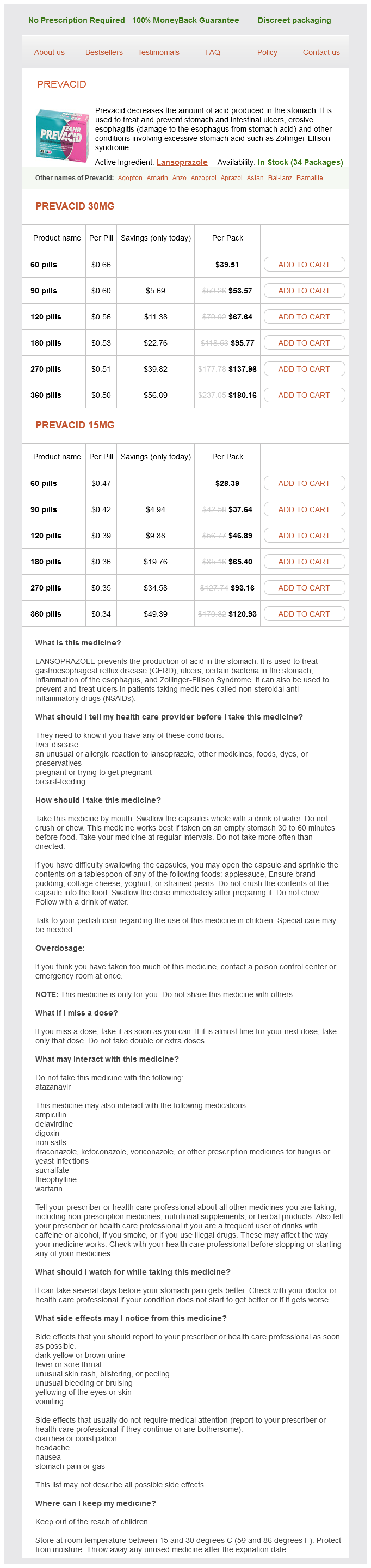
Prevacid 30mg
- 60 pills - $39.51
- 90 pills - $53.57
- 120 pills - $67.64
- 180 pills - $95.77
- 270 pills - $137.96
- 360 pills - $180.16
Prevacid 15mg
- 60 pills - $28.39
- 90 pills - $37.64
- 120 pills - $46.89
- 180 pills - $65.40
- 270 pills - $93.16
- 360 pills - $120.93
Prevacid dosages: 30 mg, 15 mg
Prevacid packs: 60 pills, 90 pills, 120 pills, 180 pills, 270 pills, 360 pills
In stock: 839
Only $0,36 per item
Description
There may also be significant aesthetic concerns gastritis symptoms belching 30 mg prevacid buy mastercard, interruption to the development of the dentition and orbital involvement gastritis diet natural remedies prevacid 30 mg without a prescription. However gastritis diet ãîãë prevacid 15 mg cheap amex, a exact classification of this group of lesions continues to be a matter of debate antral gastritis diet plan prevacid 30 mg purchase mastercard. Fibrous dysplasia and ossifying fibroma can current a nasal obstruction in a younger child and differentiating between the 2 conditions may not all the time be potential. Fibrous dysplasia has three subtypes: monostotic, which entails one website and accounts for 70 % of cases; polyostotic, which entails a number of bony sites and a polyostotic kind with extraskeletal abnormalities (McCune�Albright syn� drome) by which there are cafe-au-lait spots and multiple endocrinopathies as a result of autonomous secretion of hormones. A mutation in a stimulatory G protein subunit (Gsa) has been found in all three subtypes of fibrous dysplasia. Fibrous dysplasia has diffusely blending margins, in contrast to the clearly defined ossifying fibroma. Fibrous dysplasia will cease rising at skeletal maturity, whereas the progression of ossifying fibroma is uncertain. Complete surgical excision of ossifying fibroma is ideal, however might not all the time be attainable. In fibrous dysplasia, surgical procedure is performed if vital compression of adjacent constructions is occurring. Endoscopic strategies have been described to excise small lesions limited to the nose or paranasal sinuses, but with intensive disease, the midface degloving approach is beneficial. Postoperative baseline imaging is required as recurrence rates are excessive and repeated procedures could also be needed. Spontaneous malignant change has been reported and is more frequent within the polyostotic kind. Affected infants might develop stertor, mouth respiratory, feeding issues, sleep disturbance and rhinorrhoea. Choanal atresia could happen in isolation, but is usually one of a variety of associated anomalies. Up-to-date account of the primary ideas of administration of choanal atresia with good follow-up. Choanal atresia: a twenty yr review of medical comorbidities and surgical outcomes. Influence of polydioxanone foil on growing septal cartilage after surgery in an animal mannequin: new elements of cartilage healing and regeneration (preliminary results). A research of anthropometric measures earlier than and after external sepoplasty in children: a preliminary research. Rhinitis may exist alone, however is incessantly accompanied by sinus mucosal changes � rhinosinusitis. As with bronchial asthma, paediatric allergic rhinitis is extra common in westernized societies, presumably related to lack of infection and to dietary elements. Infection is probably initially viral, typically with subsequent bacterial superinfection. The organisms most frequently implicated are Streptococcus pneumoniae, Haemophilus influenzae and Moraxella catarrhalis. Clinically, there could also be facial ache, purulent rhinorrhea and headache, particularly if the frontal sinus is involved. Classical therapy is with analgesia and antibiotics,31 presumably plus decongestants and/or steam inhalation. The antibiotic chosen must be essentially the most slender spectrum agent available towards the likely pathogens. Recent studies suggest that additional use of topical nasal corticosteroids34, 35 or antihistamine36 plus antibiotics is associated with a more rapid resolution of signs. The pathophysiology in kids is similar as that in adults (see Chapter 109, Allergic rhinitis), nonetheless, since sensitization starts regionally within the nostril, skin prick exams could additionally be unfavorable for the primary year or two of signs in kids. Small kids could additionally be meals allergic and have rhinitis as an additional symptom to atopic dermatitis, bronchial asthma or failure to thrive. With growing age these meals sensitivities are normally misplaced and inhalant sensitivities (housedust mite, animal dander) gained. Rhinoviruses trigger over a third of viral colds and have many different subtypes with out immune cross protection. Gwaltney28 has shown that paranasal sinus membranes are involved in the frequent cold and should remain involved for up to six weeks after, though symptoms often remit inside days. There is proof that paediatric rhinosinusitis remits with rising age at around seven Chapter eighty three Paediatric rhinosinusitis] 1081 years, in related style to otitis media with effusion. The signs embrace cough, and persistent rhinosinusitis has been mistaken for bronchial asthma. There are some special types of paediatric rhinosinusitis which are mentioned in the following section. Transient hypogammoglobulinaemia Maturation of the immune system is slow in some youngsters who expertise recurrent infections as quickly as the extent of maternal immunoglobulin subsides at around three to six months. Subsequent delayed maturation takes place so that by round three years the kid is not critically troubled. Cystic fibrosis this autosomal recessive inherited situation entails abnormalities of the chloride channel in secretory cells resulting in thick sticky mucus which strikes poorly. Several different mutations on the lengthy arm of chromosome 7 have been identified, the most common affecting the delta 508 gene. Deficiency of IgA is common in the inhabitants, affecting round 1/5000 folks, half of whom endure from recurrent infections. Transient IgG deficiency can happen in childhood, with adult levels only being reached by round age 12. IgG1 is directed in opposition to protein allergens and makes up some 60�70 p.c of the whole; subsequently, deficiencies in different subclasses could also be missed if only complete immunoglobulin levels are measured for the explanation that complete IgG degree is normal. Since many of the organisms affecting the higher respiratory tract in childhood are carbohydrate coated (Haemophilus influenzae, Staphylococcus aureus, Streptococcus pneumoniae), this deficiency is probably relevant in 5 % of the paediatric rhinosinusitis inhabitants, a few of whom fail to make adequate antibody responses to Pneumococcal or H-influenzae B immunization. It is a fancy eight-chained polypeptide and genetic single amino acid mutations occur causing decreased levels in 5 p.c of the population. Chronic ailments corresponding to renal failure are related to an elevated prevalence of upper respiratory tract infections. Lack of splenic operate, both due to earlier surgical removing or compromise by illnesses similar to sickle cell anaemia and malaria, is associated with impaired resistance to infection, notably with Pneumococci. Polyvalent pneumococcal vaccine ought to be given previous to splenectomy and sufferers followed for his or her capacity to make anti-pneumococcal responses. Protein�calorie malnutrition is frequent in poorer international locations, however milder forms exist in affluent western societies where kids incessantly have poor diets due to excess consumption of junk foods. Iron deficiency anaemia was thought to be associated with susceptibility to an infection, however a recent paper disputes this. Particularly relevant factors are: past evidence of allergic disease (atopic dermatitis, asthma), purulence of nasal discharge, whether or not this ever remits, and the size of the historical past. Associated circumstances are widespread and enquiries must be made about otitis media with effusion, tonsillitis, sleep issues, bronchial asthma and chest infections. Environmental influences similar to allergens present in the residence, parental smoking and day care are relevant. A differential prognosis contains obstructive disorders such as choanal atresia and international body, particularly if the problem is unilateral. Adenoid hypertrophy with postnasal house bacterial colonization also presents with similar signs to these of continual rhinosinusitis. Ability to nose-breathe must be tested together with some estimation of the nasal airway which could be so simple as spatula testing. Nasendoscopy will provide more detail, however is troublesome in young children with out anaesthetic. The state of the mucus membranes, nature of any discharge and any structural abnormalities must be noted. Chapter 83 Paediatric rhinosinusitis] 1083 exception is acute rhinosinusitis not resolving with remedy after 48 hours, when a plain x-ray may show an empyema of the maxillary antrum. They are not often useful as a diagnostic process except abnormalities corresponding to choanal atresia or encephalocoele are suspected in a toddler with predominately obstructive symptoms or if extension of acute sinusitis to the orbit or the mind is suspected. Otherwise they provide a helpful street map in rare instances where surgical intervention is important. As with adults, some people get hold of extra benefit than others from this form of remedy. There are only a few trials of therapy for chronic rhinosinusitis, especially in youngsters. Removal of potential underlying contributing elements (allergens, pollution, infection), would appear wise.
Shamouti Sweet Orange (Sweet Orange). Prevacid.
- What is Sweet Orange?
- Dosing considerations for Sweet Orange.
- Asthma, colds, coughs, eating disorders, cancerous breast sores, kidney stones, and other conditions.
- High cholesterol.
- What other names is Sweet Orange known by?
- Preventing high blood pressure and stroke.
- How does Sweet Orange work?
Source: http://www.rxlist.com/script/main/art.asp?articlekey=96874
First alternative of surgical therapy for acute or continual frontal sinus illness gastritis kidney pain prevacid 30 mg with mastercard, proof against gastritis diet ñåðèàëû purchase 30 mg prevacid fast delivery medical therapy diet makanan gastritis prevacid 15 mg buy lowest price, is the endonasal method utilizing the microscope and/or endoscope as visible aids gastritis exercise prevacid 30 mg buy with amex. Endonasal micro-endoscopic resection has to be considered increasingly as a minimally traumatizing means for complete resection of many appropriately sized benign and likewise some malignant tumours of the nose, paranasal sinuses and anterior skull base. A potential examine using one or different surgical possibility alternately would be of great benefit. The principle of preservation or main resection of the middle turbinate in severe polyposis is another area of intensive discussion where better evidence is required. A potential research comparing the longterm outcomes after alternative application of 1 or other methodology in similar cases would be of major benefit. Prospective long-term studies (ten years or more) are necessary to obtain extra information about the long-term outcomes and late surgical issues. Recent research demonstrates the important position of fungi in persistent eosinophilic fungal rhinosinusitis. In the future, it will be attention-grabbing to see if the combination of particular medical and surgical treatment will result in higher results. Normale und pathologische anatomie der nasenhoehle und ihrer pneumatischen anhaenge, 2nd edn. Transnasale, endoskopische chirurgie der nasenebenhoehlen bei chronischer sinusitis. Frontal sinus surgical procedure: endonasal endoscopic osteoplasty somewhat than external osteoplasty. Die rolle der lateralen nasenwand in der pathogenese, diagnose und therapie der rezidivierenden und chronischen rhinosinusitis. Klinik, diagnostik und chirurgie der vorderen schaedelbasis und ihrer angrenzenden gebiete. Beitrag zur kosmetisch befriedigenden operativen versorgung von schweren zertruemmerungsfrakturen der stirnhohlenvorderwand. Die sofortige rekonstruktion der stirnhoehlenvorderwand nach frontobasalen zertruemmerungsfrakturen. Specifications, indications, and scientific functions of the Luhr vitallium maxillofacial system. Biodegradable miniplates (Lactosorb): long-term leads to infant minipigs and medical results. Endoscopically guided frontal sinus beclomethasone instillation for refractory frontal sinus/ recess mucosal edema and polyposis. Indication, surgical approach, dangers, mismanagement, and complications, revision surgical procedure (Die chirurgische behandlung entzuendlicher erkrankungen der nasennebenhoehlen. Indikation, operationsverfahren, gefahren, fehler und komplikationen, Revisionschirurgie). Image-guided endoscopic sinus surgical procedure: Result of accuracy and efficiency in a multicenter medical study utilizing an electromagnetic tracking system. Rhinochirurgische aufgaben bei der chirurgie des an die schaedelbasis angrenzenden gesichtsschaedels. Diffuse nasal polyposis: Postoperative long-term outcomes after endoscopic sinus surgery and frontal irrigation. Eine neue methode zur erhaltung der vorderen stirnhoehlenwand bei radikaloperationen chronischer stirnhoehleneiterungen. Nasofrontal duct reconstruction with silicone rubber sheeting for inflammatory frontal sinus disease: Analysis of 164 instances. Combined external and endoscopic frontal sinusotomy with stent placement: A retrospective evaluate. Bewegungsstoerung des augapfels nach stirnhoehlenoperationen (formen, vermeidung, therapie). Teil I: Die endonasale stirnhoehlendrainage bei entzuendlichen erkrankungen der nasennebenhoehlen. Zur diagnose und therapie der erkrankungen der nebenhoehlen der nase mit ausnahme des sinus maxillaris. Frontal sinus surgical procedure: endonasal drainage as a substitute of an exterior osteoplastic approach. Endonasal frontal sinusotomy in surgical management of chronic sinusitis: A critical analysis. Endoscopic endonasal remedy of ostium of the frontal sinus and the outcomes of endoscopic surgery. Modified transnasal endoscopic Lothrop process as a substitute for frontal sinus obliteration. Modified Lynch procedure for continual frontal sinus ailments: Rationale, technique, and long term results. Extended endoscopic frontal sinus surgical procedure to interrupted nasofrontal communication caused by scarring of the anterior ethmoid. Osteoplastic frontal sinus surgery with fats obliteration: Technique and long-term outcomes utilizing magnetic resonance imaging in eighty two operations. Langzeitergebnisse nach stirnhoehlenoperationen: Vergleich extranasaler und endonasaler operationstechniken. Obliteration of the frontal sinus: State of the artwork and reflection on new supplies. Radiographic analysis and prognosis of the failed osteoplastic flap with fat obliteration. Spaetbefunde nach osteoplastischer stirnhoehlenveroedung bei rezidivierenden eiterungen. Current ideas of frontal sinus surgery: An appraisal of the osteoplastic flap-fat obliteration operation. The use of cancellous bone for frontal sinus obliteration and reconstruction of frontal bony defects. Endonasal micro-endoscopic surgical procedure of tumors: State of the artwork and long-term results. Ultrasound diagnosis of Osgood Schlatter and Sinding�Larsen�Johannson diseases for the knee. Osteoma of the fronto-ethmoid sinus with secondary abscess and intracranial mucocele: case report. Rigid endoscopy in minimally invasive remedy of tumors of the paranasal sinuses and cranium base. Die endonasale Chirurgie der Nasennebenhoehlen � konzepte, techniken, ergebnisse, komplikationen, revisionseingriffe (endonasal surgery of paranasal sinuses � ideas, techniques, results, complications, revision surgery). Heidelberg: Springer, 1996: S155�269 (published in supplement to European Archives Oto-Rhino-Laryngology). Sinonasal cavities: Inflammatory illnesses, tumors, fractures, and postoperative findings. Inverted papilloma of the nostril and paranasal sinuses: Diagnosis, operative process and evaluation of the cytokeratin profile. Preliminary report: Endoscopic versus external surgical procedure in the management of inverted papilloma. A survey of contemporary management of frontal sinus illness within the United Kingdom. It is feasible that the frontoethmoidal space is more susceptible to mucocoele formation as a end result of the complexity of its drainage, as in comparison with the sphenoid and maxillary sinusus. There could additionally be a considerable time lag between the initiating factor and the clinical presentation with the mucocoele. In the case of surgical procedure or trauma this is a median of 23 years, whereas following an acute infective episode the mean time to presentation is 22 months. Percentage 37 23 21 eleven eight Although raised strain within the mucocoele has been reported, the histological appearances of the mucocoele lining are in opposition to this, being composed of pseudostratified, pseudocolumnar epithelium with some squamous metaplasia, goblet cell hyperplasia and a cellular infiltrate reflecting both acute and/or persistent irritation. The abnormalities on a preoperative ophthalmic evaluation of 120 patients are proven in Table 119. Endoscopic examination could reveal the expanded mass presenting within the nasal cavity and acute infection, and/or makes an attempt at drainage might result in fistulas by way of the higher lid.
Specifications/Details
Results from studies investigating the position of topical antiseptics in chronic suppurative otitis media should be obtained soon gastritis pictures cheap 15 mg prevacid. Prospective gastritis erythema generic 15 mg prevacid amex, randomized controlled trials of topical antiseptics against topical quinolones should make clear the treatment of alternative for decreasing otorrhoea on this illness gastritis zungenbelag cheap prevacid 15 mg on-line. Improved access via canalplasty appears more probably to gastritis diet øðåê prevacid 30 mg purchase line be rewarding and further analysis into the advantages of this method is needed. Improved understanding of the factors driving the deterioration of the tympanic membrane from atrophy through retraction to cholesteatoma may improve decision making on this illness. The function of the fibre-guided laser in cholesteatoma surgery ought to be additional investigated. The laser provides a new technique of accommodating the battle between illness removing and practical integrity of the ear. There remains the thrilling risk of elevated preservation of the ossicular chain with this technique. Chapter 74 Chronic otitis media in childhood] 959 $ $ $ Surgical outcomes for the issues of chronic otitis media are highly depending on the operator so efforts to promote an entirely evidence-based approach will proceed to be bedevilled by lack of generalizability. Nonetheless, there are numerous elements of surgery of the tympanic membrane, cholesteatoma and ossicles that might be evaluated with potential and randomized studies. In the absence of high-level proof, the most effective means of improving choice making for many surgeons might be through recording private outcomes of surgical procedure. A database of such outcomes will provide the surgeon about his/her success with different strategies for given surgical issues. Improvements in the collection and awareness of outcome knowledge will be the first step in this course. Temporal bone histopathology in chronically infected ears with intact and perforated tympanic membranes. Physiology of the eustachian tube in the pathogenesis and administration of center ear effusions. A systematic review of medical research addressing the prevalence, aetiology, diagnosis, prognosis and therapy of otitis media in Australian Aboriginal kids. Otitis media in Inuit kids in the Eastern Canadian Arctic � an summary � 1968 to date. Epidemiology of chronic suppurative otitis media amongst Saudi children � a comparative examine of 20 years. Prevalence and danger factors of persistent otitis media in Korea: outcomes of a nation-wide survey. Bacterial colonisation of the nasopharynx predicts very early onset and persistence of otitis media in Australian Aboriginal infants. Onset of otitis media in Australian Aboriginal infants in a longitudinal research from start. Longitudinal observations (1987�1997) on the prevalence of center ear disease and associated threat elements amongst Inuit children of Inukjuak, Nunavik, Quebec, Canada. Patterns of persistent otitis media in the first year of life in Aboriginal and non-Aboriginal infants. Onset of otitis media in the first eight weeks of life in Aboriginal and non-Aboriginal Australian. Chronic suppurative otitis media in the Solomon Islands: a prospective, microbiological, audiometric and therapeutic survey. Clinicomicrobiologic analysis of lively tubotympanic kind continual suppurative otitis media. The light at the finish of the tunnel associated with the high prevalence of chronic otitis media among Inuit elementary school kids in the Eastern Canadian Arctic is now seen. Benefits of swimming pools in two distant Aboriginal communities in Western Australia: an intervention examine. Medical management of persistent suppurative otitis media without cholesteatoma in children. Randomised comparitive efficacy of clindamycin, metronidazole and lincomycin, plus gentamicin in persistent suppurative otitis media. Effectiveness of ototopical antibiotics for continual otitis media in Aboriginal children: a community-based, multicentre, double-blind randomised managed trial. Use of aminoglycoside-containing ear drops in the presence of a perforation: proof evaluate. Topical ofloxacin versus systemic amoxicillin/clavulanate in purulent otorrhea in kids with tympanostomy tubes. Safety of ofloxacin otic and other ototopical remedies in animal fashions and in humans. The character and consequences of disturbing sound sensations in retraction type center ear disease. Middle ear cholesteatoma � etiology, relation to continual adhesive otitis media, and therapy: an otophotographic examine. Tympanic membrane atrophy, scarring, atelectasis and attic retraction in persistent, untreated otitis media with effusion and following ventilation tube insertion. Assessment of issues of the condition and of the therapy of otitis media with effusion. Proceedings of the Sixth International Conference on Cholesteatoma and Ear Surgery. The surgical administration of the pars tensa retraction pocket in the child � results following simple excision and ventilation tube. Congenital cholesteatoma of the center ear in youngsters: a clinical and histopathological report. Histological observations of amniotic fluid cellular content within the ear of neonates and infants. Cholesteatoma behind an intact tympanic membrane: histopathologic proof for a tympanic membrane origin. Has the growing use of grommets influenced the frequency of surgical procedure for cholesteatoma Chapter seventy four Chronic otitis media in childhood ventilation tubes for secretory otitis media. Prevalence of continual otitis media in a randomly selected population from two communes in southern Vietnam. The use of ventilation tubes and the incidence of cholesteatoma surgical procedure in the paediatric population of Liverpool. Magnetic resonance examination of the inner ear and cerebellopontine angle in sufferers with vertigo and/or irregular findings at vestibular testing. Postoperative cholesteatoma: are claims for the canal wall down approach justified Bacciu S, Pasanisi E, Perez Raffo G, Avendano Arambula J, Piazza F, Bacciu A et al. Recurrence after staged cholesteatoma surgery with bone pate repair of the lateral attic wall. Paper offered at Seventh International Cholesteatoma Conference, the Hague, 2004. Histopathological correlates of residual and recurrent conductive listening to loss following tympanoplasty and stapedectomy. The affect of pathological and technical variables on hearing results in ossiculoplasty. Proceedings of the sixth international conference on cholesteatoma and ear surgery. Analysis of the finiteelement methodology of tranfer function of reconstructed middle ears and their postoperative adjustments. Optimum tension for partial ossicular alternative prosthesis reconstruction within the human center ear. Comparison of the mechanical performance of ossiculoplasty utilizing prosthetic malleus-to-stapes head with a tympanic membrane-to-stapes head assembly in a cadaveri center ear mannequin. The opinions expressed are largely based mostly on the personal expertise of the authors. This chapter presents a resume of the widespread anomalies and a dialogue of the remedy options. Both hearing problems and deformity of the pinna can cause a substantial quantity of misery. In a 38-day-old embryo, six hillocks have developed in the mesenchymal tissue of the primary (mandibular) and second (hyoid) arch and a means of fusion produces a primitive ear in the 50-day-old embryo. Of the second arch hillocks, four and 5 produce the anti-helix and the helix, with 6 contributing to the posterior lobule. This is supported by the arterial supply of the ear where hillocks 1, 2 and 3 correspond to the territory of the superficial temporal artery and hillocks 4, 5 and 6 to the distribution of the posterior auricular artery.
Syndromes
- The health care provider will shave and clean the groin area over an artery. A numbing medicine (anesthetic) is injected into the skin over an artery and a needle is inserted into an artery.
- Which direction does the ridging go?
- Asymmetry: one half of the abnormal skin area is different than the other half
- Sick sinus syndrome
- Always tell your health care provider and dentist if you have a history of heart valve disease or congenital heart disease before treatment. Guidelines recommend antibiotics for some patients, but only under certain conditions.
- Viral hepatitis (hepatitis B or hepatitis C)
Related Products
Additional information:
Growth is usually sluggish gastritis diet õîëîäíîå cheap prevacid 15 mg without prescription, and fast progress is more suggestive of lymphoma arising in an intraglandular lymph node antral gastritis diet plan prevacid 15 mg order with mastercard. The majority happen throughout the parotid gland but they could the relative proportion of salivary tumours in children which show to be malignant is higher in kids than in adults gastritis diet äíåâíèê proven 30 mg prevacid, though of course total gastritis tea 15 mg prevacid purchase fast delivery, salivary neoplasms in kids are extraordinarily rare. Most malignant salivary gland neoplasms in childhood present merely as an enlarging mass. In children this can normally require basic anaesthetic and assessment of salivary gland histology is notoriously troublesome. Ultrasonic imaging of the salivary mass is simple to perform, noninvasive and well tolerated by children. These children and their households are finest handled in a designated centre where the entire range of assist providers for children with cancer is available. As with benign neoplasms, wide surgical excision is required for malignant tumours. It is essential to counsel the child and oldsters rigorously previous to operation relating to the attainable want for facial nerve sacrifice. The surgical margins on the specimen have to be marked and evaluated by the pathologist and adequacy of excision confirmed. Provided the excision margins are passable, no adjuvant remedy is indicated. The Mayo clinic series shows just one recurrence out of 14 malignant circumstances who had their major remedy on the Mayo. The recurrence price was greater in instances referred after preliminary treatment in a nonspecialist centre. The rarity of salivary tumours in children is such that treatment should only be in specialist centres. Best scientific practice [Treatment of acute suppurative parotitis is with analgesics hydration and antibiotics. Diagnostic and therapeutic management of atypical mycobacterial infections in youngsters. Nontuberculous mycobacterial adenitis: effectiveness of chemotherapy following incomplete excision. Efficacy of pulse dye laser therapy for the therapy of ulcerated haemangiomas: a evaluate of seventy eight sufferers. � Deficiencies in current information and areas for future research $ $ $ $ the implementation of vaccination programmes all through the growing world would tremendously scale back the morbidity of mumps encephalitis and deafness. Salivary gland neoplasms are so rare that randomized controlled studies will not be attainable; a nationwide register of these tumours and remedy only in centres where enough expertise is on the market would enhance outcome. The long-term sequelae of treatment in survivors, palliative care and future developments shall be addressed. The the rest are bone and gentle tissue sarcomas and miscellaneous tumours (see beneath beneath Miscellaneous tumours). Up to 12 percent of main childhood malignancies originate in the head and neck space and so may current to the otolaryngologist. Lymphoma is the most common prognosis in all series, followed by thyroid and neural tumours. Sarcomas and salivary gland tumours are less frequent and squamous cell carcinomas are rare. The commonest age group affected is 15 to 18 yr olds, carefully followed by the beneath fours. The underlying aetiology of the noninherited types remains unclear but sure chemotherapeutic agents, viruses. Other potential carcinogens are suspected but not proven (pollution, parental publicity to toxins, electromagnetic fields). Studies have suggested that the best predictors of malignancy in cervical lymphadenopathy are the size of the node, the number of websites concerned and the age of the affected person. Other concerning features would be lymphadenopathy in the supraclavicular region, an related abnormal chest x-ray or fixed lymph nodes. Imaging with the help of a paediatric radiologist can often obviate the necessity for biopsy. However, full assessment of a mass may require examination underneath anaesthetic with biopsy. Chapter ninety eight Tumours of the pinnacle and neck in childhood] 1253 to play in the baby than the grownup. Imaging of the neck is extra accurate than clinical examination in detecting lymphadenopathy. Support services are therefore very important in reassuring and supporting all the individuals involved. The amount of data that any youngster will require concerning their sickness relies upon to some extent on the age and maturity of that particular person. Most youngsters aged six or more (and some more mature youthful children) must know their sickness has a reputation and what that name is. In youngsters between the ages of six and eleven, these procedures and side effects of treatment might provoke much more nervousness than the sickness itself. For instance, loss of hair or a limb seem much more real and distressing than the prospect of demise. Alterations in physical look may cause nice insecurity in a baby or adolescent, leading to isolation and poor vanity. Children aged round eleven and over will have fears surrounding the prognosis and its prognostic implications along with the above. Working at the aspect of the medical employees are social workers, nurses, dieticians, psychologists and other well being care professionals to be able to present complete assist for kids and their households. The emphasis on centralization of paediatric oncology companies, the sharing of knowledge and the institution of worldwide working teams has resulted in the publication of a selection of remedy protocols which are broadly used within the management of youngsters with most cancers. The practicalities of investigating and treating children with most cancers provide some particular challenges. Venous access for blood sampling and to administer chemotherapeutic agents could be troublesome, and indwelling venous catheters are normally inserted at an early stage. Radiotherapy could require general anaesthesia in youthful sufferers to ensure that the kid remains still throughout irradiation. Children tolerate the immediate side effects of chemotherapy and radiotherapy significantly better than adults but the long-term sequelae of such interventions can have a really significant effect on the health of childhood most cancers survivors (see beneath under Long-term sequelae of treatment). In most conditions, when the kid is old enough, he or she must be included in any dialogue about investigations and remedy and they should even be involved in consent for any procedures required. The analysis of cancer in a baby has an amazing influence not only on the affected person, but in addition on parents, siblings, other family members and pals. Immediate involvement of a specialist paediatric multidisciplinary oncology team is obligatory. An open and realistic strategy should embody a proof of what to expect from the investigations and treatment, the side effects and some concept of prognosis. This is vital in maintaining trusting relationships with the kid and his or her household, in reducing uncertainty, stopping inappropriate hope and permitting proportionate adjustment. They can also feel responsible about making their youngster undergo a collection of invasive investigations and radical treatments. Lymph nodes in the neck bigger than 2 cm are unusual in childhood and systemic symptoms corresponding to weight loss, fever and organomegaly are normally indicators of significant pathology. Most lymphomas of the pinnacle and neck area within the paediatric age group present with enlarged cervical lymph nodes. There are several classifications but the universally accepted one is the Rye classification. It has the propensity to involve the lower cervical, supraclavicular and mediastinal lymph node groups. Bone marrow biopsy and bone scan are solely indicated in children with more superior disease. Treatment is dependent upon the age and bodily maturity of the affected person, the illness stage and bulk and the potential treatment sequelae. In the paediatric population, the development is to deal with in multimodality style in order to reduce the morbidity and mortality related to high doses of chemotherapy or radiation therapy wanted for single modality remedy. Lymphadenopathy happens in 50�80 p.c of all sufferers and forty five percent have cervical lymphadenopathy on the time of presentation.
Usage: b.i.d.
As this site is accessible for nasendoscopy gastritis diet webmd buy prevacid 30 mg overnight delivery, biopsies may be taken gastritis diet coconut water buy prevacid 15 mg with amex, which can be useful in establishing the prognosis gastritis diet ðîññèÿ generic prevacid 30 mg with mastercard. Cleaning the crusts by nasal lavage reduces symptoms and prevents the sequelae of an infection gastritis diet cookbook order prevacid 30 mg with visa. In arteriosclerosis, Osler�Weber�Rendu illness and juvenile angiofibroma, nasal bleeding could be troublesome to management. The objective is to see if the scale of the nose are in harmony with the face and to establish developmental disturbances. As a rule of thumb, the size of the nose should be approximately a third of the space between the hairline above the forehead and the lower border of the chin. The latter gives an impression of the support of the tip by the septal cartilage and particular attention should be paid to the development of the maxilla and dentition, since this can be associated to pathology of the nostril. Nasal trauma in childhood manifests itself in a small and infantile nostril or a deviation. A cartilaginous saddle nose and a retracted columella are indicators of poor help of the nasal pyramid by the septum, typically brought on by lacking cartilage and scar retraction within the septum. A deviated nose or a luxation or subluxation of the caudal septal cartilage is at all times found with a septal deviation. The shape of the nostrils and the tip projection are intently related to the geometry of the vestibule and the scale of the valve space and as such are signs related to practical problems. Inspection of the inner nostril begins with the nostrils, vestibule and valve area. First, the mucosa is inspected for swelling, vulnerable blood vessels, secretions, pus, crusts, atrophy and dysplasia. Congestion of the mucosa can mask or accentuate pathology associated to the skeleton, such as septal deviations, spurs and crests. In order to observe these properly, decongestion by adrenaline or similar is strongly beneficial. Photography, rhinomanometry, acoustic rhinometry and olfactometry are the standardized goal investigations to evaluate septal pathology. They are useful to evaluate the results of the treatment and are sometimes valuable for medicolegal functions. In instances the place progress may be influenced and cosmetic adjustments are anticipated, preoperative pictures is indicated. This is especially important in youngsters, in cases of cosmetic surgical procedure and in septal surgery which influences the support of the nasal dorsum, the tip and the columella or in corrections of cartilaginous deviations of the nasal pyramid. A minimum of four pictures is taken according to a normal protocol exhibiting not only the nose, but additionally the face as an entire. The commonplace protocol is important to have the flexibility to examine photographs taken at different instances. A normal collection consists of a frontal view, a left and right side view and a basal view. In rhinomanometry, two graphs are produced, one representing the connection between the stress and move in the right half of the nostril and the other in the left half of the nose. Nonlinearity makes it troublesome to categorical the relation between pressure and circulate in a single amount corresponding to resistance. The nasal cycle describes the rhythm during which the airflow is divided between the left and right nasal passages. Acoustic rhinometry is a method of measuring the crosssectional area of the nose as a operate of the gap into the nostril. Reflections of a sound wave despatched into the nostril characterize these cross-sectional areas. Reflections from the anterior a half of the nose are stronger than those from the posterior half. Olfactometry is indicated when there are signs associated to odor or for medicolegal reasons. These signs are also seen in sufferers with a straight septum and, conversely, deviated septa with out signs are additionally a common discovering. A widespread mistake is to attribute a sense of nasal blockage to a septal deviation, where mucosal pathology or poor aerodynamics are the cause of the complaints. Nasal blockage in a seemingly normal nasal cavity is extra often related to lack of knowledge of the pathology than with psychological factors. Consequently, the potential for making a correct suggestion for a septoplasty for practical causes is limited. Of course there are clear-cut indications similar to a whole or practically complete obstruction of the airflow, impaired drainage of the sinus or inaccessibility of the nasal cavity for surgical procedure, for instance in nasal polyposis. The indications for septal corrections for aesthetic reasons are in general extra simple than those for functional causes. Two strips of cartilage were left behind, one to preserve the dorsum and the other to hold the tip and columella in place. Despite these strips, scar formation and subsequent contraction of the fibrous tissues within the resected part of the septal cartilage have been a frequent cause of saddling and retraction of the columella. Septal perforations had been a common complication, partially as a end result of drying of the opposing mucoperichondrium adjoining to the incision. Another downside of this system was that correction of pathology within the dorsal, caudal, inferior and posterior parts of the septum was not attainable. In 1963, Cottle and van Dishoeck gave a course on nasal surgery in Leiden that laid the foundations for modern nasal surgery in Western Europe. The basic concepts have been to reconstruct instead of resect and to take care of function and cosmetics in one process. Furthermore, the open approach, as promoted by Sercer17 and Padovan18 and reintroduced by Goodman19 and others, discovered its place in nasal surgery. In the surgical process, there are six phases: (1) having entry to the septum; (2) correction of pathology; (3) eradicating pathology; (4) shaping removed cartilage and bone; (5) reconstruction of the septum; and (6) stabilizing the septum. There is little question that there are patients who profit from a septoplasty for useful causes. Nevertheless, the number of patients with no or restricted gain from the procedure in the lengthy run is giant. Then, between the cartilage and the perichondrium an anterior tunnel is made on either side. After tunnelling, the inferior part of the septum can be detached from the anterior nasal spine, premaxilla and the maxillary crest. Next an incision between the posterior part of the septal cartilage and the bony septum could be made. After these two procedures, the septum could be moved apart, quite like a swinging door. Correction of septal pathology A deviation because of tension in the septum, or an inferior edge that has slid alongside the spine or a maxillary crest, could be corrected by eradicating an inferior cartilaginous strip. Dislocations due to fractures could be handled intraseptally by mobilization or resection of parts of the septum. Removing septal pathology More severe deformities require resection of elements of the septum and typically of the septal cartilage as a complete. After that, the resected area should be reconstructed ideally with the autologous supplies already removed. Nevertheless, resection ought to be restricted as a lot as potential to keep away from trauma and problems. Retraction of connective tissue can alter an excellent result immediately after surgical procedure into a poor result after some months to a year. The dynamics of the therapeutic process should be understood to allow acceptable correction of the septum. Reshaping must be done with as little trauma as possible, with maximum preservation of straight parts of the septum. Other supplies similar to ear or rib cartilage can be used in its place, but are second alternative. The use of cartilage from a tissue financial institution carries the chance of transmitting infectious brokers, such as prions and viruses, and requires an excellent understanding of the mechanical properties of the donor materials. A sturdy strip of cartilage under the cartilaginous dorsum should forestall a saddle nostril. Tip projection is preserved and retraction of the columella is prevented by a strip of cartilage within the caudal part of the septum.
Tags: purchase 15 mg prevacid free shipping, prevacid 30 mg order with visa, discount prevacid 15 mg overnight delivery, purchase 15 mg prevacid with mastercard, discount 15 mg prevacid visa, 15 mg prevacid buy with visa, order prevacid 30 mg, 30 mg prevacid cheap mastercard, prevacid 15 mg order online, prevacid 30 mg generic visa, 15 mg prevacid purchase visa, generic prevacid 15 mg without prescription, buy generic prevacid 30 mg on line, order 30 mg prevacid with visa, generic prevacid 30 mg on-line, 15 mg prevacid buy with mastercard
9 of 10
Votes: 198 votes
Total customer reviews: 198
Customer Reviews
Jesper, 30 years: For phonation studies, ideally a small amount of barium is run to each nostril and then sniffed to coat the taste bud. Combination therapy with corticosteroids and cyclophosphamide is given and co-trimoxazole could additionally be utilized in the lengthy term to scale back remissions. One such factor is the age at which the listening to loss was identified, in addition to habilitative assist supplied.
Gorok, 33 years: Plain radiography often offers a clue in these instances, because of the lack of the septae in the air cell system, as properly as the cloudiness as a outcome of the presence of the cholesteatoma. It is helpful to direct the history taking with a number of principal and most probably diagnoses in mind. To reply specific questions relating to the frontal sinus, nasal endoscopy is crucial.
Torn, 37 years: For youngsters with normal cognitive talents, this language advantage was found throughout all take a look at ages, communication modes, degrees of listening to loss and socioeconomic backgrounds. Paradoxical impact of physique positioning on gastroesophageal reflux and gastric emptying in the premature neonate. Survivors of childhood cancer are at an increased danger for a variety of disabling psychological issues corresponding to low mood, low shallowness and anxiety.
Dan, 46 years: This has the obvious advantage from the perspective of both operator and patient, significantly if a toddler, of lowering intraoperative blood loss to a minimal. This is in marked distinction to the roughly 20 % seen within the regular inhabitants. Significant aspiration requires endoscopic repair of the cleft in two layers, using a nasogastric feeding tube until the suture line has healed.
Renwik, 49 years: In 20 % of instances the suprastructure could additionally be irregular, with one crus being absent (monocrural) or there being no recognizable crura but instead a single strut (monopodial). The symptoms embrace cough, and chronic rhinosinusitis has been mistaken for asthma. Accurate, agency stabilization using external pins: A proposal for closed discount of unfavorable nasal bone fractures and their easy classification.