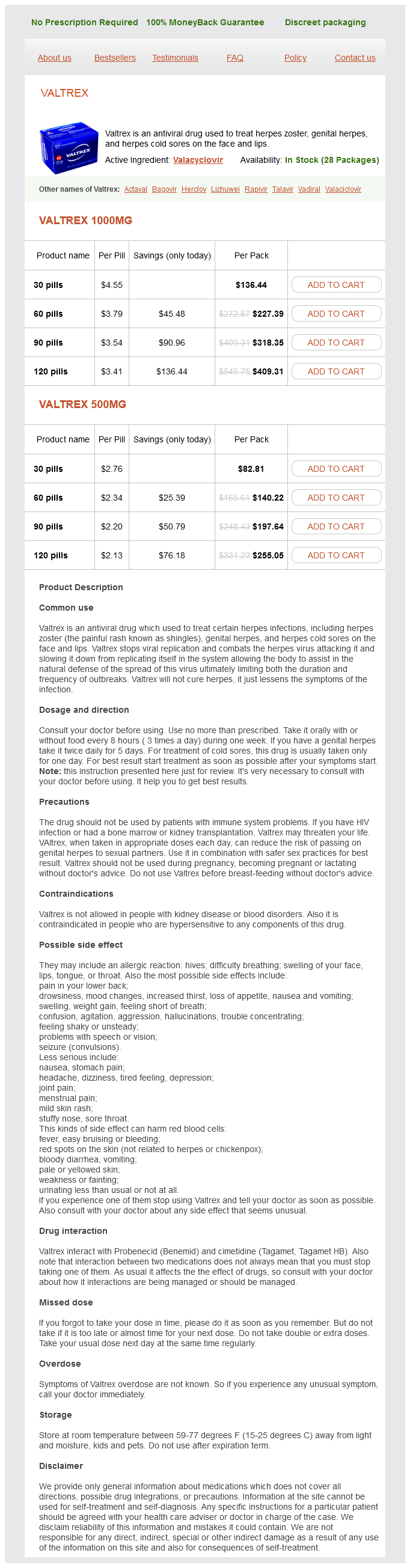
Valtrex 1000mg
- 30 pills - $136.44
- 60 pills - $227.39
- 90 pills - $318.35
- 120 pills - $409.31
Valtrex 500mg
- 30 pills - $82.81
- 60 pills - $140.22
- 90 pills - $197.64
- 120 pills - $255.05
Valtrex dosages: 1000 mg, 500 mg
Valtrex packs: 30 pills, 60 pills, 90 pills, 120 pills
In stock: 634
Only $2,26 per item
Description
To maximize the identification of membrane proteins hiv infection rates 2014 500 mg valtrex cheap with mastercard, several totally different proteomic strategies have been employed anti viral sore throat 1000 mg valtrex overnight delivery. Proteomics and posttranslational protein modifications in Toxoplasma gondii using streptavidin beads hiv infection diagram valtrex 500 mg purchase on-line. The modifications identified on -tubulin included acetylation of Lys40 hiv infection gay top discount 1000 mg valtrex with visa, removing of the last Cterminal amino acid residue Tyr453 (detyrosinated tubulin), and truncation of the final five amino acid residues. An antibody specific for mammalian -tubulin lacking the final two C-terminal residues (2-tubulin) labeled the apical region of this parasite. Detyrosinated tubulin was diffusely current in subpellicular microtubules and displayed an apparent accumulation at the basal end of tachyzoites. Several of the identified proteins were validated utilizing immunolocalization and genetic strategies. A total of 279 proteins were recognized, with the best ranking proteins being secreted proteins. A complete of one hundred fifty of the 421 proteins had been hypothetical and an additional one hundred forty had no beforehand defined position or experimentally determined localization in T. Twenty two of 37 of these uncharacterized proteins had been localized to the mitochondrion by immunostaining. Ubiquitination requires the action of ubiquitin-activating enzyme E1, ubiquitinconjugating enzyme E2, and ubiquitin-ligating enzyme E3. In addition, proteins involved in vesicular trafficking, ion transport, and translation are ubiquitinated. K63) were discovered to be current in Toxoplasma, where they exhibited differential ranges and localization patterns in a cell cycle�dependent method (Dhara and Sinai, 2016). Proteomics and posttranslational protein modifications in Toxoplasma gondii entails the addition of a 16-carbon palmitic acid to a cysteine residue through a labile acylthioester linkage (Corvi et al. G proteins, ion channels, receptors, cytoskeletal proteins, kinases, and signaling proteins have been found to be palmitoylated (Martin and Cravatt, 2009; Wan et al. Proteins localizing to rhoptries and other organelles of the invasion machinery are also palmitoylated (Caballero et al. Studies using lectin affinity chromatography have recognized over a hundred glycosylated proteins in T. O-linked proteins were also purified utilizing Vicia villosa lectin chromatography (Wang et al. Arginine methylation is found on histones of many eukaryotes (Molina-Serrano et al. Proteomics and posttranslational protein modifications in Toxoplasma gondii various features. Arginine methylation of transcription factors can inhibit their degradation by preventing phosphorylation occasions required for ubiquitinmediated destruction (Yamagata et al. Histone acetyltransferases switch the acetyl group from acetyl coenzyme A to the amino group of lysine, classically on the N-terminus of histones to form 3-N-acetyl lysine. In addition to the subset of acetylation marks that were identified in intracellular, replicating tachyzoites (Jeffers and Sullivan, 2012), an additional 339 novel acetylation marks have been reported (Xue et al. A whole of a hundred and twenty candidate proteins have been identified by no much less than two peptides together with proteins concerned in chromatin and transcriptional equipment, ribosomal biogenesis, and translation, rhoptry proteins, and stress related proteins. Interestingly, more than one quarter of succinyllysine proteins localize to the mitochondrion. Another quarter of succinyllysine proteins localize to the essential parasitespecific organelle, the apicoplast, which is important for fatty acid and isoprenoid synthesis (McFadden and Yeh, 2017). This construction is highly modified by palmitoylation, ubiquitin, phosphorylation, and methylation. Proteomics and posttranslational protein modifications in Toxoplasma gondii (Silmon de Monerri et al. All glideosome proteins are phosphorylated in areas which might be conserved among the Apicomplexa (Jacot and Soldati-Favre, 2012; Treeck et al. Overall, these findings suggest a job for this closely phosphorylated region in protein�protein interactions related to parasite motility (Nebl et al. This is consistent with the massive number of invasionrelated proteins which may be palmitoylated (Foe et al. Together, these information recommend that parasite motility and invasion require tight regulation of palmitoylation. Tubulin ubiquitination regulates its polymerization, inhibiting microtubule formation (Bheda et al. Differences in ribosomal protein acetylation might play a role within the international downregulation of translation in extracellular parasites (Xue et al. While in the extracellular surroundings, parasites are exposed to a number of stressors, corresponding to a lack of nutrients, which might alter the pool of obtainable acetyl-CoA. Proteomics and posttranslational protein modifications in Toxoplasma gondii atypical ubiquitin chains have additionally been found in different organisms (reviewed in Ikeda and Dikic, 2008). Overall, ubiquitin-like modifiers are implicated in transcriptional regulation in P. These experiments could be difficult due to the quantity of material required for global proteomic evaluation. This contains exclusion of phosphotyrosine from merozoites and differential distribution of the core motif (K/R)xx(S/T) in merozoites and schizonts in vivo (Lasonder et al. Although bradyzoites can be induced in vitro, obtaining large quantities of pure bradyzoites required for proteomic evaluation is challenging and few laboratories have access to the sexual stages or oocysts. Extracellular tachyzoites bear transcriptional and translational arrest (Croken et al. Fewer ubiquitinated proteins had been detected in extracellular tachyzoites compared to intracellular parasites (Silmon de Monerri et al. This suggests that ubiquitination has a role in regulating metabolism in extracellular tachyzoites. It is possible that arginine methylation performs a job in transcriptional suppression as a outcome of stress. Proteomics and posttranslational protein modifications in Toxoplasma gondii apoptosis, reorganize cellular microtubules, associate mobile organelles with the parasitophorous membrane, and alter immune regulatory pathways. There are documented changes within the host proteome in parasitized cells, for instance, differential phosphorylation (Nelson et al. In addition to modifying host cell proteins, lots of the proteins secreted into the host cell by either Plasmodium spp. The studies talked about on this chapter present data supporting crosstalk Toxoplasma Gondii 22. Significant overlap was seen between arginine monomethylated and phosphorylated proteins. The ubiquitination and palmitoylation proteomes had been also significantly enriched for the proteins in every dataset. Post-translational modifications as key regulators of apicomplexan biology: insights from proteome-wide research. As seen in different eukaryotes, the phosphoproteome is enriched in kinase and phosphotransferase capabilities and is enriched in nuclear proteins. A role for succinylation in metabolism and mitochondrial processes been described in other eukaryotes (Park et al. Mitosis is closely linked to cytokinesis, as a end result of endodyogeny (see Chapter 21: Regulation of gene expression in Toxoplasma gondii). There are distinct G1 and S/M regulated subtranscriptomes on this organism (Behnke et al. Similar to the traditional eukaryotic cell cycle, checkpoints assess progress of the cell via numerous phases of the cell cycle in T. Ubiquitination is an essential regulator of checkpoint management during the cell cycle, as ubiquitination of checkpoint complexes enables development through cell cycle checkpoints (Bassermann et al. The phosphoproteome and arginine monomethylome are uniquely enriched within the genes upregulated in mid-G1 (4. This enrichment of upregulated mid-G1 proteins in the phosphoproteome and monomethylome probably indicates a necessity for elevated signaling, gene regulation, and protein synthesis related to the cell development typically seen in G1. At this G1/S checkpoint the cell is getting ready for replication and duplicates the Golgi and centrioles (Hartmann et al. In genes upregulated between hours 3 and 4 of the S/M subtranscriptome ubiquitination, phosphorylation, and palmitoylation are significantly enriched. The S/M part of the cell cycle is essential for guaranteeing parasite integrity is maintained and mitosis happens correctly.
Phenylalanine Methyl Ester HCl (Phenylalanine). Valtrex.
- Dosing considerations for Phenylalanine.
- Are there any interactions with medications?
- Pain.
- How does Phenylalanine work?
- Attention deficit-hyperactivity disorder (ADHD).
- What other names is Phenylalanine known by?
- What is Phenylalanine?
- A skin condition called vitiligo.
Source: http://www.rxlist.com/script/main/art.asp?articlekey=96643
In patients which we protect the native left upper quadrant organs anti viral echinamide 1000 mg valtrex generic with amex, a everlasting native portocaval shunt is created earlier than or immediately after completion of the native hepatectomy hiv infection symptoms wikipedia 500 mg valtrex with amex. After we do the arterial conduit q significa antiviral buy valtrex 500 mg amex, we bring the allograft to the sphere and begin the vascular anastomosis of both the arterial influx and venous outflow of the en bloc contained organs antiviral trailer generic valtrex 500 mg without a prescription. Then we cannulate the infrarenal aorta and flush the organs, and we cross-clamp the thoracic aorta. The retrieval begins with the removal of the suprarenal aorta en bloc with the take offs of the celiac axis and superior mesenteric artery and finishes with the mobilization of the liver along with the retrohepatic vena cava like in the isolated liver retrieval. In multivisceral or liver, pancreas, and intestine grafts, the venous drainage is established by anastomosing the suprahepatic donor cava to the primary confluence of the native hepatic veins. The gastrointestinal reconstruction is commonly dictated by the surgical anatomy of the retained native intestine organs and the kind of visceral allograft. Stomach inclusion within the allograft will necessitate pyloroplasty to permit gastric emptying of the denervated stomach. [newline]Sometimes, chylous ascites is developed after the consumption of a fat-containing food regimen. Immunosuppression the sector of intestinal and multivisceral transplantation has skilled important obstacles as a result of the chance of destructive alloimmunity. Intestinal transplant recipients typically require more profound immunosuppression than patients receiving different solid organs due to the higher immunogenicity of the intestine. Immune recognition is provided through pathogen-associated molecular patterns, the sign transduction of which is mediated by toll-like receptors. However, newer immunomodulatory strategies have emerged in 1995 such as bone marrow cell infusion and low-dose allograft irradiation as properly as the common use of induction therapy (cyclophosphamide, daclizumab). Recently, interleukin-2 receptor antagonists have been used as induction agents, in addition to for maintenance immunosuppression. Whole pancreas allo-transplantation Postoperative management 185 including induction of tolerance with adoptive regulatory T cells or other immune cell therapy together with the introduction of reliable immune assays, will undoubtedly improve security and further the goal of reaching full tolerance on this challenging population. An efficient posttransplant group consists of transplant physicians, surgeons, intensivists, anatomical pathologists experienced in the interpretation of intestinal allograft biopsies, transplant nurses, dieticians, pharmacists, coordinators, and stomal therapists. With the invention of molecular diagnostic techniques and newer antimicrobial brokers, improved postoperative care has reduced rates of rejection, an infection and mortality, and improved outcomes. Historically, transplant intestine has been thought of to be extremely immunogenic and subsequently, most centers use comparatively heavy immunosuppression in comparison with different stable organ transplants. With such immunosuppression, cell-mediated rejection has decreased to some extent; nevertheless, the sufferers are extra doubtless to experience infections. One of the most important contributions has been the introduction of induction remedy and recipient preconditioning to the tacrolimus-based immunosuppression regimen. Immunomodulatory strategies, including donor pretreatment, bone marrow augmentation, and allograft irradiation, have also been used to enhance the end result with multivisceral transplantation. Hypogammaglobulinemia is common after intestine transplantation,60 and extreme hypogammaglobulinemia might have an opposed impact on infection-related morbidity and mortality. Monitoring of the recipient alloimmune response and allograft functions has been the central core of postoperative care. Rejection of the pancreatic allograft is suspected in patients with vital elevation of serum amylase and lipase, with out evident causes of nonimmunologic pancreatitis. The dynamic strategy of graft vs host response with the establishment of macrochimerism and microchimerism has been recently monitored by the serial detection of circulating donor cells within the recipient peripheral blood. Also, the short tandem repeat technique has been extra incessantly used in current years. Pancreas transplantation in the setting of multivisceral transplantation the achievement of full dietary autonomy has required versatile and sophisticated administration methods. The goal is to begin enteral feeding as early as possible after transplantation. Ileus normally persists for the primary few postoperative days as ischemia-reperfusion damage resolves. These are gradually increased in quantity, as tolerated, whereas intravenous fluids or parenteral diet are concurrently weaned. The optimal price at which to advance feeds has not been decided, however the aim is to provide all nutritional necessities enterally, with complete withdrawal of parenteral vitamin inside 4�6 weeks. Because gastric emptying is delayed early after transplantation, jejunal feeding is the preferred route, mostly via a jejunostomy, customary at the time of the transplant. Up to 45% of kids have continued to require nasogastric tube feeding at 2 years; forty elements corresponding to meals aversion, high relative fluid, and power requirements, and prior opposed dietary experiences with an inclination to anorexia, typically contribute to delayed transition. Enteric lymphatics are sometimes disrupted throughout surgery, with restoration typically taking weeks to months. In the occasion of this complication, most centers choose a low-dose lipid formulation (1 g/kg or 1 g/100 mL feed) initially, with or without medium chain triglycerides; these are absorbed through the portal circulation, quite than lymphatics. Monitoring of dietary parameters is significant, not only as the transition to oral intake happens but additionally in the lengthy term. Iron studies, B12, zinc, and selenium levels are different important nutrients to monitor. The excessive prevalence of the metabolic bone disease in this population requires common bone mineral densitometry. The stomal output is monitored intensely within the early postoperative period when elevated output might portend rejection, viral enteritis, or systemic infection, in addition to ischemic harm or surgical complication. Despite the complexity of the process, perioperative mortality is rare in experienced palms, and hospital stay has decreased drastically prior to now decade, with a quantity of sufferers leaving the hospital in fewer than 3 weeks with complete enteral autonomy with out the need for parenteral hydration or nutrition. Trypsin activity begins to get into play 10 weeks posttransplant, and it could be detected in stoma effluent, serum C peptide stage will increase to normal around the first posttransplant month, and triples in regards to the third posttransplant month. Also, extreme manipulations of the gut could additionally be injurious and may result in the launch of proinflammatory mediators that worsen the posttransplant end result. It is characterized by intraoperative hypotension, low cardiac output, and elevated pulmonary arterial wedge stress. It accommodates osmotically lively substances such as hydroxyethyl starch that allows better and more effective flushing, and raffinose A. Whole pancreas allo-transplantation Infections 187 and lactobionate to cut back swelling of cells. Hyperkalemic cardiac arrhythmias and arrest, and microcirculatory issues due to crystal formation have been recorded with the utilization of this resolution. Histidine acts as a buffer, tryptophan acts as a membrane stabilizer, and ketoglutarate acts as an power substrate. The longest chilly ischemia time with profitable graft survival in the early posttransplant period was 14 h. Arterial pseudoaneurysm a process thought to be facilitated by abdominal infection, ischemia during graft harvesting owing to disruption of the vasa vasorum, or excessive doses of immunosuppression80 and might lead to graft or patient loss. Stenosis or thrombosis of vascular supply might compromise the arterial provide or the venous drainage of the allograft. Arterial thrombosis could trigger the typical imaging features of bowel ischemia, whereas venous thrombosis is extra likely to manifest as bowel wall edema, with a variable level of enhancement. Thrombosis in the portomesenteric venous system is also prone to produce perfusion abnormalities within the liver. Fistulas from the native pancreaticoduodenal advanced can complicate combined liver-intestine grafts in recipients with pancreaticoduodenal preservation. Acute graft pancreatitis in cluster abdominal organs is the commonest explanation for deadly or severe technical issues in Pittsburg group during the first posttransplant year,84 incidence 30%. Hyperglycemia reported after distal pancreatectomy of pancreatic rejection and insulin is used to treat it. The price of such problems has diversified throughout reports however might be within the vary of 10%�15%, although much greater rates have been reported. Although a lot of the enteric anastomosis is done aspect to side and in two layers, still both anastomotic leak or stenosis is a potential supply of quick postoperative complications. Anastomotic leak could also be a supply of intraabdominal assortment and abscess, and stenosis can cause bowel obstruction. The vascular system is a potential supply of critical issues in the quick postoperative interval, vascular problems including bleeding or thrombosis, both arterial or venous. Although vascular complications can occur at any time, arterial issues including thrombotic events and pseudoaneurysm formation are relatively unusual, with a prevalence of three. Infection is also the second most typical cause associated with graft loss after rejection. Pancreas transplantation in the setting of multivisceral transplantation population of immune cells, intraluminal commensal microorganisms present within the bowel allografts, and lack of bowel mucosal barrier with bacterial translocation.
Specifications/Details
Finally antiviral principle 500 mg valtrex discount overnight delivery, similar to hiv throat infection symptoms cheap valtrex 1000 mg fast delivery what has been advised for phagosomal antigens (Blander hiv infection mosquito bite valtrex 1000 mg cheap with amex, 2018; NairGupta et al hiv infection rates south africa order 500 mg valtrex otc. Remarkably, a selection of features differ regarding the processing mechanisms of membrane-bound antigens. Indeed, displacing the C-terminal epitope reduces its immunogenicity, and inserting a subdominant epitope to the C-terminal position ameliorates the response (Feliu et al. P62 might bind to and goal vacuolar antigens to the proteasome although the character of the ubiquitinated targets remains unclear (Jensen, 2016; Lee et al. In cell sorts corresponding to human glioblastoma cells, major rat astrocytes, microglia (Luder et al. The parasite effector(s) responsible for this impact was initially reported to be a rhoptry and/or dense granule-derived soluble protein (Leroux et al. Rupture of the cyst or oocyst structure within the intestinal lumen liberates parasites, which invade the surrounding host cells, convert into fast-replicating tachyzoites and disseminate throughout the lamina propria, gut-associated lymphoid tissues earlier than reaching more distant tissues. To migrate via the epithelium and attain the lamina propria, the parasite uses numerous mechanisms involving lysis of infected enterocytes (Chardes et al. After getting into the lamina propria, the parasite invades leukocytes and features entry to the lymphatic and blood system. While parasite replication in the gut is observed inside the first week of an infection (Bonnart et al. Mice develop large necrosis of the villi and severe ileitis, which trigger dying of the animals within 10 days. Although the protecting capacity of those IgA responses remains illdefined, eliciting them might characterize a beautiful mucosal vaccination technique. Consistently, administration of an adenosine receptor agonist improves immunopathology within the gut (Francois et al. These T cells are useful, and they are often reactivated by subsequent gastrointestinal tract infection (Hand et al. However, the adaptive immune responses in the intestinal surroundings have remained poorly investigated in the course of the chronic part. These processes underscore the essentiality of regulatory mechanisms that allow the host to restrict tissue damage and acute mortality. Furthermore, explicit courses of lipid mediators concerned in antagonizing or in resolving Toxoplasma Gondii 26. While within the rat, genetic variations in innate immune response result in dramatic variations in resistance to preliminary infection (Chapter 7 "Toxoplasma animal models and therapeutics"), in mice, a distinction within the capacity to control infection during the persistent phase has been characterized. Most research on the in situ dynamics of antigenspecific T cells in the context of T. Similar observations were made in mesenteric lymph nodes following intraperitoneal an infection (John et al. Intriguingly, stable contacts with parasitized target cells exposed T cells to direct invasion by parasites, which could be observed passing from the target cell to the T cells upon goal cell lysis. Moreover, at 1 week after infection, 50% of parasitized cells within the blood are T cells, and blocking T cell egress from the lymph nodes resulted in lowered spreading to the spleen and nondraining lymph nodes (Chtanova et al. Thus, while the predominant function of T cells is protection of the host, they might also be exploited by the parasites to aid in their unfold through the body. A pure collapse of Treg cells is associated with higher virulence of sure parasite strains and with deadly end result. Depending on the mix of homing receptors (homing "signature"), T cells preferentially turn into outfitted to enter a selective tissue. Adaptive immunity vitamins according to neuronal wants and defend the mind from toxins and pathogens. To enter the brain parenchyma, T cells then secrete matrix metalloproteases, permitting them to cross the glia limitans, a construction shaped of processes from astrocytic finish toes (Engelhardt and Ransohoff, 2012). A second barrier is found at the degree of the choroid plexus, a structure answerable for the synthesis of the cerebrospinal fluid. However, these molecules are expressed on the apical floor of epithelial cells and are due to this fact hidden from the immune cells inside the choroid plexus parenchyma. The transmigration by way of this epithelium is tightly regulated though the mechanisms are still not totally uncovered. This construction consists of endothelial cells and is morphologically distinct from the opposite two. In specific, the blood�leptomeningeal barrier is devoid of astrocytic finish feet, making it a more permissive web site of infiltration (Meyer et al. T cell infiltration through this barrier is decided by P-selectin, which is constitutively expressed by the endothelial cells of this barrier (Engelhardt and Ransohoff, 2012). Yet they persist in situ only if parasites categorical the cognate antigen (Schaeffer et al. Adaptive immunity inflammatory foci result in death of the animals by 9�12 days posttreatment (Gazzinelli et al. Consistent with immunosuppressive cytokines being important for preventing deadly immunopathology during T. If the pathogen is cleared, a phase of contraction usually leaves behind only a small variety of central and effector reminiscence T cells that provide protecting immunity against reinfection. During acute phase, the mind parenchyma is invaded by Toxoplasma gondii tachyzoites, which may infect many cell sorts including neurons. The major roles ascribed to this subset are to guarantee protection from a secondary problem [i. Genes corresponding to Klf2 and S1pr1 are downregulated, whereas several genes associated with extracellular adhesion and migration are upregulated. Again the useful relevance of those cells on this context stays to be investigated. On day 30 postinfection, these mice exhibit intensive inflammatory infiltrates in muscle with a marked Th1 profile, correlating with vital muscle weak spot compared to uninfected management mice. This myositis is associated with sustained accumulation of inflammatory monocytes and macrophages. Using Treg depletion and switch experiments, this research unexpectedly discovered that Treg cells inhibited the switch of macrophages towards a repair-prone phenotype, thereby stopping muscle tissue regeneration (Jin et al. This is in contrast to the pro-repair function of tissue Treg cells in different settings (Burzyn et al. Understanding these immune responses and parasite manipulation of the host immune response is crucial for understanding the pathogenesis of infection and consequence of an infection. These responses are driven by the genetic diversity of each the host and the parasite. Insights into these genetic variations are beginning to provide explanations for the varying illness manifestations that can happen following an infection. All of these components provide the foundation for the development of protecting immunity and inform therapeutic methods for illness prevention. Exogenous pathogen and plant 15-lipoxygenase provoke endogenous lipoxin A4 biosynthesis. Behavior of neutrophil granulocytes during Toxoplasma gondii an infection in the central nervous system. Immunodominant, protecting response to the parasite Toxoplasma gondii requires antigen processing within the endoplasmic reticulum. Persistence of Toxoplasma gondii within the central nervous system: a fine-tuned balance between the parasite, the brain and the immune system. Definitive identification of a gene that confers resistance towards Toxoplasma cyst burden and encephalitis. Adoptive transfer of intestine intraepithelial lymphocytes protects towards murine an infection with Toxoplasma gondii. Sec22b regulates phagosomal maturation and antigen crosspresentation by dendritic cells. Antibody responses to Toxoplasma gondii in sera, intestinal secretions, and milk from orally contaminated mice and characterization of goal antigens. Mucosal and systemic mobile immune responses induced by Toxoplasma gondii antigens in cyst orally infected mice.
Syndromes
- Name of product (as well as the ingredients and strength, if known)
- Sardines (with the bones)
- Stroke
- Wash the cut thoroughly with mild soap and water.
- Look for changes that may lead to a high-risk pregnancy
- Numbness and tingling
- Diarrhea
- Alpha-1 globulin: 0.1 to 0.3 g/dL
- Has sudden chest pain or other symptoms of a heart attack
- 120 dB -- a jackhammer about 3 feet away
Related Products
Additional information:
Whereas long-term outcomes have improved hiv infection elderly purchase 500 mg valtrex with mastercard, graft losses during the first year (early graft failure) remained secure hiv infection rates 2014 cheap valtrex 1000 mg free shipping, between 10% and 15% hiv infection of dendritic cells discount valtrex 500 mg fast delivery. Causes of pancreas allograft failure Histological findings Three major morphological findings could be encountered in pancreas allograft failure hiv infection detection valtrex 500 mg generic. Those findings combined with the scientific context may lead the clinicians to different diagnostic speculation. A necrotic pancreatic tissue could be the consequence of early technical failure (mostly thrombosis) and acute antibody-mediated rejection. Widespread tissue fibrosis associated with the disappearance of islets could outcome from continual T-cellmediated rejection or persistent antibody-mediated rejection. Primary islet dysfunction, with regular appearing islets without irritation or fibrosis of the pancreas parenchyma, can be found in recurrence of type 1 diabetes, growth of kind 2 diabetes, and -cell calcineurin toxicity. Histological evaluation of late allograft pancreatectomy can inform on the etiologies leading to pancreas allograft failure. Another group described 13 patients with late allograft failure resulting in pancreatectomy due to stomach pain. In our heart, early pancreas loss occurs within the first days posttransplant, with a median incidence of seven days. Pancreas failure in the first posttransplant year is mostly as a result of technical failure. Other causes are primarily associated to technical failure (bleeding, fistula, and infections). Interestingly, we lately started to monitor kind 1 diabetes autoantibodies posttransplant. Diagnostic strategy To assess permanent allograft failure, clinicians should undertake explorations to exclude a reversible reason for pancreas allograft dysfunction. Histological findings like intensive fibrosis could additionally be in favor of permanent allograft failure. At first, glycemia, amylase and/or lipase, C-peptide, and HbA1c should be assessed. This step goals to differentiate rejection from type 1 diabetes recurrence and calcineurin inhibitor toxicity. Early graft failure Owing to each examine, early graft failure might refer to graft loss before 3-months posttransplant or during the first yr. When enteric exocrine drainage is chosen, access to the graft is reduced via the percutaneous biopsy approach. In the context of pancreas allograft failure, the risk/benefit balance is in all probability not in favor of performing a core-needle biopsy, because the graft is usually small and retracted, growing the danger of complications. Risk components of pancreas allograft failure Factors related to pancreas allograft failure may differ owing to the transplantation era. Indeed, surgical technique (nowadays enteric exocrine drainage more than bladder drainage), donor choice and immunosuppressive therapy modified over time. Nowadays, the commonest surgical method contains an enteric exocrine drainage and a systemic venous drainage. Risk components of early pancreas allograft failure Technical failure (loss because of surgical issues and thrombosis) is the first cause of graft loss within the first yr and happens in round 10% of pancreas transplant recipients. Risk components for pancreas failure at 1 year are largely preoperative and perioperative elements. Another study from the same staff emphasised on the influence of donor obesity on pancreas transplant outcome. Enteric exocrine drainage was significantly associated with an elevated technical failure rate in comparison with bladder drainage in 2005�09 period however there was no difference in the newest period. We found no association between recipient parameters at transplantation and graft failure. Donor age and donor hypertension had been associated with poor 1-year graft survival in univariate evaluation however no issue remained important in multivariate analysis. Donor death from cerebrovascular cause was associated with poor graft end result with out reaching significance (unpublished data). Thus, risk elements for early allograft failure are mainly associated to the donor (donor obesity, age, death from a cerebrovascular cause) and the perioperative period (preservation time over 24 h, low center-volume). Risk elements related to the recipient (obesity and immunological status) and to the surgical technique (enteric vs bladder exocrine drainage) are inconsistently found in numerous studies. Because of the excessive influence of donor components on early pancreas allograft survival, indexes to facilitate donor selection have been created. Whole pancreas allo-transplantation Risk components of pancreas allograft failure 333 (cold ischemia time) with a cut-off of 12 h. They integrated these 5 elements in a Composite Risk Model for technical failure danger. Two or extra risk components predicted technical failure, underlying the significance of donor choice and decreased preservation time. Risk components of long-term allograft failure After 1 12 months, technical failure is uncommon whereas immunological events symbolize a large a half of allograft failure causes. Thus, danger elements for long run pancreas allograft failure might differ between the 2 durations. In an Austrian cohort, donor age, transplant quantity, and transplantation time had been unbiased components related to 10-year pancreas allograft survival in multivariate analysis. In our middle in Nantes, donor death from cerebrovascular trigger was the one danger issue for long-term graft survival identified. These information underline the impact of donor parameters and graft preservation not solely on early allograft survival but additionally on long-term outcomes. In their registry evaluation of pancreas transplantations between 2005 and 2014 in the United States, Gruessner et al. For solitary pancreas, younger recipient age was a powerful danger issue whereas enteric drainage was protective. After exclusion of sufferers with early graft failure, these knowledge point out the significance of immunological elements after the first year posttransplant. A more modern examine together with 227 pancreas transplantations performed between 1998 and 2009 highlighted the influence of an acute pancreas rejection episode on long-term pancreas survival, with a very robust influence of rejection during the first 3 months posttransplant. Early technical and infectious issues and immunologic events strongly influence long-term outcomes. Evaluation of glucose homeostasis to predict long-term allograft failure Identifying predictive markers of pancreas dysfunction may enable investigations and intervention earlier than irreversible graft damage. Indeed, when these two parameters are above the normal vary, the biggest part of the endocrine tissue may already be destroyed. Other parameters of glucose homeostasis have been reported to be early predictors of late allograft dysfunction. Exploration of glucose homeostasis aims to detect insulin resistance and defect of insulin secretion. Distinguishing insulin resistance from the defect of insulin secretion can already information diagnostic hypothesis. The gold commonplace method to research glucose homeostasis is the euglycemic hyperinsulinemic clamp. The beta-score (-score) has been developed and validated in islet cells transplantation to assess -cells function. HbA1c ranges showed a mild however significant enhance over time, with a imply HbA1c at 10 years of 5. Insulin secretion was normal everywhere in the follow-up in the normal glucose tolerance group. Paradoxically, glucagon secretion was greater in patients with impaired or diabetic glucose tolerance. On the opposite, insulin secretion was significantly lower in patients with impaired and diabetic glucose tolerance. These markers are diverse, some reflecting insulin secretion and others insulin resistance, and are assessed at totally different time factors. Thus, the heterogeneity of these research makes it tough to spotlight a selected marker for prediction of pancreas allograft failure.
Usage: p.o.
It is now nicely established and secure symptoms of hiv infection in early stage valtrex 500 mg buy visa, with very low risk of problems regardless of utilizing systemic anticoagulation therapy with therapeutic-dose heparin hiv infection rates in the caribbean cheap valtrex 500 mg on-line. After procurement hiv transmission method statistics valtrex 1000 mg discount without prescription, the donor pancreas is sent to the islet isolation middle the place the pancreatic duct is cannulated and the pancreas distended with collagenases ginger antiviral purchase valtrex 500 mg mastercard. The pancreas is then sectioned and transferred into the Ricordi chamber for mild mechanical agitation. The enzymatic answer is recirculated for 15�30 min at 37�C resulting in gradual digestion of the pancreas. The final islet preparation is placed in culture media for 24�72 h earlier than it launched for clinical transplantation by means of percutaneous transhepatic intraportal infusion. Islet allo-transplantation Islet isolation and transplantation 677 under with intermittent portal vein pressure measurement, if the baseline port strain exceeds 20 mmHg, or rises above 22 mmHg throughout infusion, no further islets are given till the stress is normalized. An ultrasound and doppler assessment of the liver and portal vein are carried out on day one and 7 following the transplant procedure to affirm the absence of bleeding or portal branch vein thrombosis. This requires common anesthesia, may induce peritoneal adhesions making entry for subsequent portal infusions potentially extra hazardous. Open surgical entry to the portal system may be achieved by recanalization of the obliterated umbilical vein, enabling entry to the left portal vein, or by restricted laparotomy and infusion of islets right into a mesenteric or omental tributary of the portal vein using a dual lumen nine French Broviac-type-central line catheter which is gently superior into the principle portal to allow portal pressure monitoring. The most frequent procedural related complication is moderate pain at the puncture site or referred ache to the best shoulder from diaphragmatic irritation occurring in about 50% of patients which largely resolve in the first 48 h with the administration of analgesics. Bleeding following islet transplantation was reported as excessive as 8% within the early Edmonton expertise. The use of purified islet allografts has not resulted in main portal vein thrombosis in the Edmonton program; however, 5% of sufferers have experienced peripheral segmental portal vein thrombosis which probably carries no sequelae. Treating diabetes with islet cell transplantation: Lessons from the Edmonton experience attributed to long-term diabetic issues, and only 3 of the 25 reported death (equating to zero. However, it does carry unwanted aspect effects which can be dose-limiting, these include, nephrotoxicity, tremor, and headache. An further necessary consideration is that many of the immunosuppressive brokers used in stable organ transplantation since the Sixties, particularly corticosteroids, are known to be toxic to islets. Since the Edmonton protocol was first described, important advances in the immunosuppression regimens have occurred. These have translated into improved brief and long-term outcomes for islet transplantation. These agents had been found to be very well tolerated by sufferers and had minimal unwanted effects. Hering and colleagues promoted the use of T-cell depleting therapies in islet transplantation. This is chosen on the premise of its potency, tolerability, sustained effect and cost. Adjunct peri-transplant anti-inflammatory brokers In the peri-transplant durations, islets are subjected to an inflammatory response within their engraftment micro-environment. These have been proven experimentally to promote engraftment of marginal human islet transplants in immunodeficient mice. Islet allo-transplantation Outcomes 679 Outcomes Several years following the landmark "Edmonton Protocol" research, the same group offered the first 5-year follow-up knowledge on scientific islet transplantation. What had not been totally appreciated by the islet transplant community at this level, was the significance of partial graft perform (80% at 5-years on this study), and its role in stabilizing glycemic control, lowering HbA1c ranges, defending in opposition to severe hypoglycemia, and slowing the progress of diabetic microvascular problems in sufferers with type 1 diabetes. The final goal is to obtain insulin independence (defined by freedom from exogenous insulin with sufficient glycemic control), here the intervention is deemed a full success. However, different outcomes may be beneficial, a transplant could be deemed partially successful when partial graft function is maintained (detectable C-peptide >0. Subjects with partial graft operate exhibited improved glycemic control in comparison with those with full graft loss (no detectable C-peptide) (HbA1c 6. Here, they reported the outcome of 677 patients who had undergone islet transplants from the 12 months 1999 until 2010. The identified partial graft perform has a big correlation with the discount of HbA1c and protection against severe hypoglycemia (demonstrated in >90% of topics at 5 years). In these countries, the price of the process is covered by the health care services (either public or privately funded). The major finish point, restoration of glycemic control (HbA1c<7% and freedom from extreme hypoglycemic episodes with the restoration of hypoglycemic unawareness) was reached in 87. Redefining the indications, selecting candidates who will benefit most from the intervention, streamlining islet isolation and purification, modulating the immunosuppression regimens, and deciding on adjuncts to assist improve islet engraftment, all translating into the acceptance of islet transplantation as a feasible and safe treatment for chosen sort 1 diabetic. Treating diabetes with islet cell transplantation: Lessons from the Edmonton expertise (n=9). The patients had been randomly allocated to receive an immediate islet transplant or intensive insulin therapy (under close supervision) for 6 months adopted by islet transplant. A whole of 46 sufferers received islet transplants, one patient within the insulin therapy group died while awaiting islet transplant of complication of nocturnal hypoglycemia. The main outcome was the proportion of sufferers with a modified -score of 6 or larger 6 months after the first infusion within the immediate transplantation group and 6 months after randomization in the insulin group. The main end point was achieved in 64% of sufferers within the instant transplant group compared to 0% in the insulin-treated group at 6 months. Those receiving an immediate islet transplant had hypoglycemic consciousness, had been free from hypoglycemia, and had considerably improved glycemic management in comparability with those handled with insulin therapy (5. Normal, or close to regular glycemic management (HbA1c<7%) was achieved in 84% vs 0% in the insulin-treated patients (P<0. At 1 12 months follow-up, after the final insulin remedy topic accomplished their islet transplant, 93% had objective graft function, 70% had regular or near-normal glycemic management (HbA1c<7%). The authors additionally famous a discount within the glomerular filtration price of sufferers who had not beforehand acquired a kidney transplant. As such they concluded for the indications assessed on this examine, islet transplantation effectively improves metabolic outcomes. However, immunosuppression can have an result on kidney perform, necessitating the cautious number of patients. Development of immune tolerance protocols Progressive graft dysfunction Long-term immunosuppression Future directions Although vital progress has been made in the field of islet transplantation during the last decade, there are still some obstacles preventing its wider adoption. Alternative engraftment websites have been investigated; probably the most promising is the gastric submucosal house. One of the principle obstacles in increasing the indications for islet transplantation is the requirement for long-term immunosuppression of the recipient; better-tolerated regimens with equipotent immune-protective properties may help justify its wider utility. Alternatively, strategies to remove the necessity for chronic immunosuppression such as using encapsulated islets to confer immune isolation while nonetheless allowing the change of vitamins may permit long-term islet survival after transplantation utilizing the quick term on decrease dose immunosuppression. Finally, insulin independence is acknowledged following single islet infusion, nevertheless, a number of infusion from a number of donors are usually required to achieve a profitable consequence. The global financial burden of diabetes in adults aged 20-79 years: a cost-of-illness study. Association between 7 years of intensive remedy of sort 1 diabetes and long-term mortality. Adverse occasions and their association with treatment regimens within the diabetes control and issues trial. Achieving HbA1c targets in scientific trials and in the real world: a scientific evaluate and meta-analysis. Comparison of pancreas transplantation with portal venous and enteric exocrine drainage to the usual method utilizing bladder drainage of exocrine secretions. Metabolic characterization of longterm successful pancreas transplants in kind I diabetes. Total or close to total pancreatectomy and islet autotransplantation for remedy of continual pancreatitis. Insulin independence of unstable diabetic patient after single residing donor islet transplantation. Treating diabetes with islet cell transplantation: Lessons from the Edmonton experience forty two. The new deceased donor pancreas allocation schema: do the suggestions go far sufficient Islet isolation for allotransplantation: variables associated with profitable islet yield and graft operate. The use of multiparametric monitoring throughout islet cell isolation and tradition: a potential tool for in-process corrections of important physiological elements. Altered islet composition and disproportionate lack of massive islets in sufferers with type 2 diabetes.
Tags: buy valtrex 500 mg mastercard, generic valtrex 500 mg without a prescription, buy valtrex 500 mg cheap, valtrex 1000 mg purchase on-line, 1000 mg valtrex purchase overnight delivery, valtrex 1000 mg generic overnight delivery, discount valtrex 500 mg without prescription, purchase 500 mg valtrex overnight delivery, valtrex 1000 mg buy generic line, valtrex 500 mg trusted, valtrex 500 mg cheap fast delivery, buy valtrex 500 mg overnight delivery, valtrex 1000 mg buy amex, 1000 mg valtrex discount mastercard, purchase 1000 mg valtrex with mastercard, buy generic valtrex 500 mg on line
8 of 10
Votes: 83 votes
Total customer reviews: 83
Customer Reviews
Merdarion, 41 years: Failure of a pancreas transplant reexposes the patient to their persistent disease state and its associated issues of dysglycemia, which can be physically and emotionally devastating.
Barrack, 58 years: Neuropathy and associated findings within the diabetes management and problems trial/epidemiology of diabetes interventions and issues research.