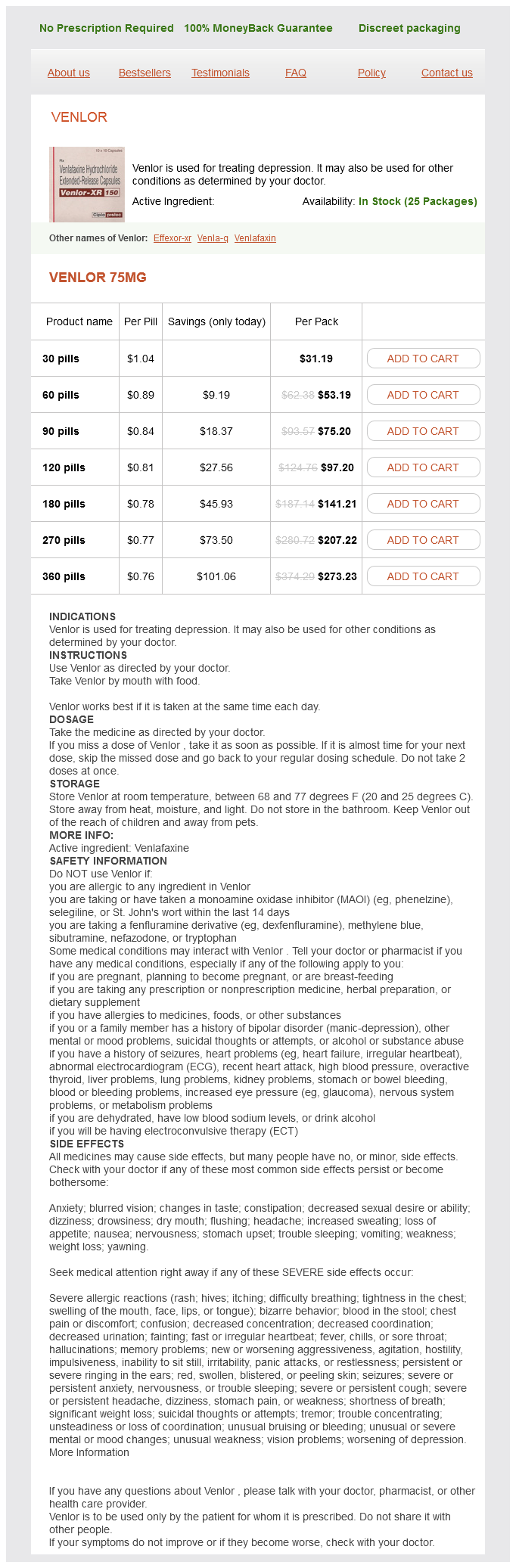
Venlor 75mg
- 30 pills - $31.19
- 60 pills - $53.19
- 90 pills - $75.20
- 120 pills - $97.20
- 180 pills - $141.21
- 270 pills - $207.22
- 360 pills - $273.23
Venlor dosages: 75 mg
Venlor packs: 30 pills, 60 pills, 90 pills, 120 pills, 180 pills, 270 pills, 360 pills
In stock: 992
Only $0,81 per item
Description
When the patient wakes anxiety symptoms one side discount venlor 75 mg free shipping, narcotics ought to be administered to provide analgesia; intermittent dosing of morphine sulfate is normally sufficient anxiety erectile dysfunction discount 75 mg venlor fast delivery, although the dosing might be highly variable and titration will be needed anxiety symptoms tongue 75 mg venlor buy free shipping. Orthotopic liver transplant recipients typically require much less analgesia than comparable hepatic resection sufferers do anxiety symptoms zika venlor 75 mg order mastercard. Dexmedetomidine is a selective -2a adrenergic agonist that offers potent sedative results and some analgesia. It has the benefit of not being associated with respiratory melancholy and should facilitate earlier extubation. Electrolytes, together with magnesium, should be measured and abnormalities corrected. Seizures often correlate with high tacrolimus or cyclosporine ranges, and thus levels should be monitored and the dosage lowered if potential. Any seizure without a discernible cause and all focal seizures necessitate a computed tomographic scan to evaluate the potential for central nervous system bleeding. The optimum anticonvulsant for upkeep therapy in this affected person inhabitants is unclear. Levetiracetam has the benefit of not needing dose adjustment in hepatic failure and not interfering with the metabolism of generally used immunosuppressive brokers. Occasionally an older baby who was beforehand in excellent well being aside from the underlying liver illness may be extubated in the operating room, however such is the exception quite than the rule. No proof helps the prevalence of any specific mode of ventilation in kids. Either an help management or a synchronized intermittent obligatory air flow mode may be used. Compliance ought to be monitored intently as a result of it might be significantly altered by adjustments in stomach distention. Several elements might make such extubation inconceivable in chosen sufferers Table 70-1). Persistent paralysis or a depressed respiratory drive secondary to encephalopathy or excessive sedation precludes fast extubation. The effusion is generally a transudate through the traumatized diaphragm from ascitic fluid within the abdomen. Aggressive diuresis is usually efficacious for each pulmonary edema and pleural effusions. Placement of chest tubes is prevented in view of the usually dilated chest wall vasculature and the coagulopathy usually present within the immediate postoperative interval. The metabolic alkalosis generally seen in the quick postoperative period leads to a compensatory respiratory acidosis. For this reason, a base extra larger than +7 is usually treated with acetazolamide. Other metabolic abnormalities such as hypophosphatemia, hypomagnesemia, hypocalcemia, and hypokalemia could lead to respiratory muscle dysfunction and an lack of ability to wean from the ventilator. These patients have variable and fluctuating degrees of abdominal distention from ascites, edematous bowel, and enormous liver grafts. This combination leads to a lower in effective pulmonary compliance and extremely variable delivered tidal volumes with the pressure-limited ventilation usually used. Peak inspiratory pressure may must be incessantly altered, and successful extubation might must await enchancment of the abdominal distention. In infants with chronic ascites and belly distention, a brief, broad chest develops, with decreased diaphragmatic motion usually leading to atelectasis. Aggressive chest physiotherapy could also be helpful to open collapsed areas of lung, but bronchoscopy could also be necessary to reexpand the atelectatic lung if the affected person is unable to wean from the ventilator. Diaphragmatic paralysis from phrenic nerve damage or direct harm to the diaphragm itself will delay extubation in a small infant. Diaphragmatic movement underneath situations of spontaneous respiratory effort must be examined with both ultrasonography or fluoroscopy to search for paradoxical diaphragmatic motion. Rarely, plication of the diaphragm to forestall paradoxical movement is critical to facilitate successful extubation. Another explanation for failure to wean from the ventilator is an inappropriately small endotracheal tube, which considerably will increase resistance to airflow and thus will increase the work of respiration. This problem requires either altering to a bigger endotracheal tube or extubating from higher levels of ventilatory help. A very ill, malnourished infant could not have enough power to wean from the ventilator, and a interval of ventilatory support followed by a gradual defined weaning program will thus be required. To continually try to wean such a affected person earlier than improvement in dietary standing solely exhausts the patient, makes use of valuable calories, and delays extubation. Nutritional help ought to provide sufficient, but not extreme, energy with adequate noncarbohydrate calories to avoid an increased respiratory quotient with the resulting excessive carbon dioxide load. A small child who continues to require ventilatory support regardless of correction of those components could have a pulmonary infection. Infants with an elevated alveolar-arterial oxygen gradient, fever, diffuse interstitial infiltrates on chest roentgenograms, and inflammatory cells on sputum Gram stain in the absence of a bacterial process usually have a viral pneumonitis. Viral cultures and antigen detection research ought to be performed on an endotracheal sputum sample. Management is mostly restricted to good supportive care, minimization of immunosuppressive brokers as tolerated, and time. Symptomatic adenoviral pneumonia has a big mortality rate on this population. Application of the fast, shallow respiration index, which is useful within the adult population, would incorrectly predict failure of a normal toddler to tolerate extubation. If the patient tolerated a 2-hour trial with acceptable SpO2, tidal quantity, and respiratory fee, extubation was performed. In a current review, Newth et al30 advocated utilizing an extubation readiness take a look at utilizing 2 hours of spontaneous respiration on continuous constructive airway pressure of less than 5 cm H2O or a T-piece. Occasionally a patient requires placement of a pulmonary artery catheter for an ongoing shock state, often sepsis, however that is unusual. A minimal systolic blood pressure of ninety to one hundred mm Hg is maintained in all patients within the quick postoperative interval for enough graft perfusion; fluid help and infrequently inotropic agents are used to maintain these perfusion 70 PostoPerative intensive Care ManageMent in Children 899 pressures. Vasopressor agents are averted and used provided that the patient remains in shock regardless of vigorous fluid support and is inappropriately vasodilated. These sufferers are invariably septic and are treated in the identical manner as different septic sufferers. In the absence of clinically important bleeding and without extreme coagulopathy, a point of reasonable hypertension is tolerated. If other pharmacological intervention is deemed needed, nifedipine in a low dose may be used. In an unstable affected person a nicardipine infusion could additionally be titrated to optimize blood strain control. One should err on the facet of underdosing initially and improve the dosage as necessary to minimize the prospect of acutely making the affected person hypotensive and perhaps rising the chance for hepatic artery thrombosis. Monitoring consists of the center rate, central venous pressure, and blood stress, as properly as hourly urine output, and clinically the adequacy of perfusion as manifested by capillary refill time is noticed. Generally fluids, including medicines, are initially restricted to approximately 60% to 80% of maintenance requirements. If the affected person has significant third spacing of fluids, fluid infusions must be increased. Because most patients are in a state of total-body sodium overload and are hyperglycemic, an answer of 5% dextrose in water and 0. Fluid losses from abdominal drains have to be monitored and will have to be replaced if excessive. Fluid administration should be reevaluated every 3 to four hours, with consideration directed to intravascular volume standing as manifested by hemodynamic monitoring, together with central venous stress and blood stress, as nicely as urine output and perfusion. Urine output should be monitored hourly with an indwelling drainage catheter and urine output maintained at more than 1 to 2 mL/kg/hr. If urine output diminishes to below this stage, the adequacy of intravascular volume needs to be reassessed and any hypovolemia corrected.
African Ginger (Ginger). Venlor.
- Is Ginger effective?
- Are there safety concerns?
- Preventing morning sickness, after discussing the possible risks with your healthcare provider.
- What is Ginger?
- Preventing motion sickness and seasickness.
Source: http://www.rxlist.com/script/main/art.asp?articlekey=96924
However anxiety in relationships generic venlor 75 mg with mastercard, distinguishing hepatic-based opposed drug occasions from rejection anxiety symptoms weakness order venlor 75 mg with amex, recurrent disease anxiety symptoms while sleeping order venlor 75 mg on-line, and different complications may be extraordinarily troublesome anxiety symptoms mind racing venlor 75 mg buy discount on line, but is uncommonly encountered. Nodular regenerative hyperplasia has been attributed to continual toxicity408 but can additionally be frequently seen in recipients not handled with this treatment. PseudoÂground-glass cells, composed of irregular glycogen and carefully resembling polyglucosan our bodies, are seen with increased frequency in liver allografts413 and may be associated to disturbed glycogen metabolism and polypharmacotherapy. Also, we apologize to the first authors and readers for the reliance on critiques and the dearth of primary literature citations: a limitation imposed on us by the editors. Liver biopsy findings from healthy potential living liver donors: reasons for disqualification, silent diseases and correlation with liver harm exams. Preoperative donor liver biopsy for adult living donor liver transplantation: risks and benefits. Living donor liver transplantation: histological abnormalities discovered on liver biopsies of apparently wholesome potential donors. One hundred consecutive hepatic biopsies within the workup of living donors for proper lobe liver transplantation. Prevalence and risk elements of non-alcoholic fatty liver illness in potential dwelling liver donors in Korea: a review of 589 consecutive liver biopsies in a single heart. Liver transplantation: official publication of the American Association for the Study of Liver Diseases and the International Liver Transplantation Society. Long-term follow-up and consequence of liver transplantation from anti-hepatitis C viruspositive donors: a European multicentric case-control study. Symptomatic and proven de novo amyloid polyneuropathy in familial amyloid polyneuropathy domino liver recipients. Rapidly growing nephrocalcinosis in a affected person with end-stage liver disease who acquired a domino liver transplant from a affected person with known congenital oxalosis. Journal of ultrasound in drugs: official journal of the American Institute of Ultrasound in Medicine. Progression of morphological adjustments after transplantation of a liver with heterozygous alpha-1 antitrypsin deficiency. Importance of liver biopsy findings in immunosuppression management: biopsy monitoring and working standards for sufferers with operational tolerance. Complement C4d immunohistochemistry in the assessment of liver allograft biopsy samples: Applications and pitfalls. Liver allograft antibody-mediated rejection with demonstration of sinusoidal C4d staining and circulating donor-specific antibodies. Re-examination of the Lymphocytotoxic Crossmatch in Liver Transplantation: Can C4d Stains Help in Monitoring? Does tacrolimus offer virtual freedom from continual rejection after primary liver transplantation? Risk and prognostic components in 1,048 liver transplantations with a mean follow-up of 6 years. Transjugular liver biopsy in patients with residing donor liver transplantation: comparison with percutaneous biopsy. Pathophysiologic Observations and Histopathologic Recognition of the Portal Hyperperfusion or Small-for-Size Syndrome. Biliary complications after liver transplantation from donation after cardiac death donors: an evaluation of danger factors and long-term outcomes from a single heart. Liver transplantation using donation after cardiac dying donors: long-term followup from a single center. Role of postreperfusion subcapsular wedge biopsies in predicting initially poor graft perform after liver transplantation. Role of hepatocytes and bile duct cells in preservation-reperfusion damage of liver grafts. Portal influx and stress adjustments in proper liver residing donor liver transplantation together with the center hepatic vein. Graft injury in relation to graft size in right lobe reside donor liver transplantation: a research of hepatic sinusoidal injury in correlation with portal hemodynamics and intragraft gene expression. Mechanism and function of intrinsic regulation of hepatic arterial blood move: hepatic arterial buffer response. Decompression of the portal bed and twice-baseline portal inflow are necessary for the practical recovery of a "small-for-size" graft. Concurrent increase in mitosis and apoptosis: a histological pattern of hepatic arterial flow abnormalities in post-transplant liver biopsies. Type of donor aortic preservation answer and not cold ischemia time is a major determinant of biliary strictures after liver transplantation. Fibrinolytic preflush upon liver retrieval from non-heart beating donors to improve postpreservation viability and energetic recovery upon reperfusion. Immunopathology of antibodies as effectors of orthotopic liver allograft rejection. Nonanastomotic biliary strictures after liver transplantation, half 2: Management, end result, and threat elements for illness development. Nonanastomotic biliary strictures after liver transplantation, part 1: Radiological options and risk components for early vs. Bile duct hemorrhage: a biopsy finding after cholangiography or biliary tree manipulation. Distinguishing between recurrent main sclerosing cholangitis and chronic rejection. Terminology of persistent hepatitis, hepatic allograft rejection, and nodular lesions of the liver. A clinicopathological study of human liver allograft recipients harboring preformed IgG lymphocytotoxic antibodies. Portal hyperperfusion: mechanism of damage and stimulus for regeneration in porcine small-for-size transplantation. Porcine partial liver transplantation: a novel model of the "small-for-size" liver graft. Liver transplantation in rats utilizing small-for-size grafts: a research of hemodynamic and morphological adjustments. Portal vein stress is the necessary thing for successful liver transplantation of an especially small graft within the pig model. Adult-to-adult live donor liver transplantation: a short-term clinicopathologic research. Pathologic analysis of right-lobe graft failure in adult-to-adult reside donor liver transplantation. Early hepatic artery thrombosis after liver transplantation: a systematic evaluation of the incidence, consequence and risk factors. Indirect immunohistochemical evaluation of graft fibrosis and interface hepatitis after pediatric liver transplantation. Preformed lymphocytotoxic antibodies: the results of sophistication, titer and specificity on liver vs. Anti-allograft antibodies: some are harmful, some can be overcome, and a few could additionally be helpful. Antibody mediated rejection as a contributor to previously unexplained early liver allograft loss. Does a optimistic pretransplant crossmatch have an effect on long-term end result in liver transplantation? Clinical perspective of acute humoral rejection after blood type-compatible liver transplantation. Donor-specific human leukocyte antigen antibodies of the immunoglobulin G3 subclass are associated with continual rejection and graft loss after liver transplantation. Clinical and Histological Predictors of Operational Tolerance in Pediatric Liver Transplant Recipients. Significance of C4d deposition in the prognosis of rejection after liver transplantation. Portal capillary C4d deposits and elevated infiltration by macrophages point out humorally mediated mechanisms in acute mobile liver allograft rejection. Description of B lymphocytes and plasma cells, complement, and chemokines/ receptors in acute liver allograft rejection. A quantitative evaluation of T lymphocyte populations in human liver allografts present process rejection: using monoclonal antibodies and double immunolabeling. Expression of adhesion molecules on lymphocytes/monocytes and hepatocytes in human liver grafts.
Specifications/Details
As a matter of conference anxiety 2016 venlor 75 mg buy with visa, reside attenuated virus immunizations are contraindicated anxiety symptoms jaw spasms 75 mg venlor cheap otc. The threat for illness development from these preparations is theoretical and has never been confirmed anxiety symptoms throat 75 mg venlor discount otc. Examples of live attenuated vaccines are smallpox anxiety symptoms for months purchase 75 mg venlor with mastercard, yellow fever, measles, mumps, rubella, and oral polio. Permitted vaccines are these for influenza, pneumococcus, hepatitis B, and diphtheria-tetanus booster (not the preliminary diphtheria-tetanus inoculation). The worth of a yearly influenza vaccine is left to the discretion of the first care physician and the patient. Clinical implications of hepatic preservation harm after grownup liver transplantation. Potential immunological advantage of intravenous mycophenolate mofetil with tacrolimus and steroids in major deceased donor liver transplantation and live donor liver transplantation with out antibody induction. Trends in invasive fungal infections in liver transplant recipients: correlation with evolution in transplantation practices. Clinical outcomes of Pneumocystis carinii pneumonia in adult liver transplant recipients. Clostridium difficile an infection in hospitalized liver transplant patients: A nationwide analysis. Antibiotic Prophylaxis Once a thriving liver transplant recipient progresses beyond 3 months, he or she might elect to undergo a procedure that was delayed because of his or her prior endstage liver illness. These procedures might involve dental work, joint surgical procedure, back surgical procedure, and different procedures. Short restoration time after percutaneous liver biopsy: ought to we change our present practices? Utilization rates, complications and prices of percutaneous liver biopsy: a population-based examine including 4275 biopsies. The incidence and risks of liver biopsy in non-cirrhotic sufferers: An analysis of 3806 biopsies. Quality of life enhancements at one, two, and 5 years after liver transplantation. Long-term administration of the profitable grownup liver transplant: 2012 apply guideline by the American Association for the Study of Liver Diseases and the American Society of Transplantation. Renal dysfunction in liver transplant recipients: evaluation of the critical points. Pregnancy outcomes of liver transplant recipients: a systematic evaluate and metaanalysis. The problems need to be identified, and the aim of remedy is to forestall irreversible injury to other organs. Preoperative care plays a important position within the health of potential recipients and consists of administration of the complications of liver failure. Organ availability continues to be a unfavorable 916 determinant, affecting survival of the pediatric affected person on the transplant record. It is essential to note that belly girth and skinfolds may be falsely increased by ascites and peripheral edema. A thorough assessment and good scientific judgment are needed to attain an accurate analysis. Correction of dietary deficiencies offers a big challenge, particularly when the liver disease is cholestatic and its onset is within the first few months of life. Nourishing youngsters with liver disease is a difficult task15,17 that requires well-timed nutritional intervention, including oral supplementation with high-calorie formulas, enteral tube feedings, and/or parenteral nutritional supplementation. The objective of those interventions is to provide a steadiness of macronutrients, micronutrients, and nutritional vitamins, all of that are paramount to improving clinical outcomes. These medically complicated youngsters are greatest managed by devoted multidisciplinary teams. Multiorgan Failure Liver failure usually leads to a singular cascade of organ dysfunctions. This can bridge the patient to organ transplantation by preventing or addressing problems. Metabolic Disorders Patients with inborn errors of metabolism generally have specific deficiencies of one or more enzymes required for substrate metabolism. These deficits result in varied biochemical derangements and medical manifestations. This additional complicates postoperative care due to technical issues and the immature physiologic standing of neonates. Some patients with metabolic disease have involvement of different organs, corresponding to brain, heart, or kidney; these issues usually have an effect on postoperative tolerance to drugs. The rationale for that is to provide adequate donor liver to produce the lacking enzymes or proteins, whereas permitting the recipient to salvage his or her personal native liver if the donor liver fails. Fulminant Liver Failure this multisystemic disorder characterised by sudden and severe hepatic damage can occur in individuals with no acknowledged prior liver illness. These sufferers usually have extreme coagulation abnormalities inserting them at elevated danger for intraoperative bleeding. The function of the systemic inflammatory response in the pathogenesis of elevated intracranial pressure has been acknowledged as an necessary issue; this supports the clinical administration of prophylactic antibiotics to enhance outcomes. These gadgets have helped stabilize patients, permitting time for spontaneous regeneration of the native liver or transplantation. It contributes to morbidity and mortality brought on by ascites and bleeding from gastroesophageal varices. There is a variable prognosis relying on the serum bilirubin degree on the time of the episode. When medical therapy fails to management portal hypertensive issues, then portosystemic shunting procedures, like transjugular intrahepatic portosystemic shunt or distal splenorenal shunts, should be thought of. The alternative of medicines to prevent rejection will typically need to be extra intensive than during the first transplant. To provide timely transplantation before decompensation of the recipient in this era of pediatric donor shortage, progressive surgical methods have been developed to yield partial or reduced-size grafts from deceased or residing donors. This procedure supports the affected person, offering adequate liver operate to bridge recovery of the native liver. Liver biopsies of both native and donor liver may be necessary to determine the source of laboratory abnormalities. Other sources for grafts to increase the donor pool for pediatric patients are donors after cardiac death. Postoperative hypertension is commonly observed and is most likely going the result of quantity shifts, medications, and discomfort. These sufferers may have significantly altered renal perform from prior treatment exposure; this can affect their postoperative management. Possible causes include extreme intravascular volume, normalization of preoperative vasodilatory tone, vagal stimulation or harm throughout transplantation, drugs, venous entry position, and mechanical air flow. Size of the Recipient Very younger and small children are at higher threat for surgical issues and require exact surgical techniques to obtain successful transplantations. This predisposes them to clinical deterioration whereas waiting and pushes the want to utilize technical variant grafts. Thus the graft is allowed to shrink to a dimension that allows closure without compromising the hepatic parenchyma. Most of these maneuvers to regulate both affected person dimension or graft size predispose recipients to early reoperations. Some facilities wait until sufferers are older than 1 year or weigh more than 8 kg earlier than accepting an organ. It is essential to know about occasions that occurred, in addition to about the fluids, medications, and blood products that were administered throughout surgery. Obtaining firsthand information from the surgical and anesthesia teams immediately after surgery is significant to understanding the complete scientific image and to the immediate management of the patient. Postoperative Orders Transplant teams commonly use standardized order units with weight-based dosing to minimize medicine errors and omissions. The fluid fee is adjusted to optimize organ perfusion as estimated by central venous pressure, coronary heart rate, blood strain, and urine output and is monitored carefully.
Syndromes
- The name of the product (as well as the ingredients and strength, if known)
- No urine output
- How effective was the attempt?
- Older children should not eat any food or drink any milk after midnight before the operation. They can have clear juice, water, and breast milk up to 4 hours before surgery.
- Vaginal discharge or bleeding after intercourse
- You notice a new mole or other growth
- Parathyroid biopsy
- For men aged 50 - 59, levels above 3.5 ng/mL
- Has a base that bleeds easily if it is banged or scraped
Related Products
Additional information:
Polystyrene microspheres are internally color-coded with two fluorescent dyes that may be detected after laser illumination anxiety xanax dosage discount 75 mg venlor. T cells are divided into two functionalsubpopulations,helperT(Th)cellsandsuppressorT (Ts)cells anxiety 025 cheap 75 mg venlor with mastercard. This software of circulate cytometry is clinically relevant to theevaluationofseronegative spondyloarthropathies anxiety keeping you awake buy venlor 75 mg without a prescription. Immunoassay systems have the potential to improve turnaroundtime,withenhancedcost-effectiveness(Box13-3) anxiety symptoms 3 days cheap 75 mg venlor with mastercard. It contains autoimmune, cancer-related, and infectious illness antibodies and/or antigens. Procedure Laboratory Activities this laboratory activity consists of viewing two movies producedbytheBeckmanCoulter,Inc. Inthelaboratory,thehydrogen bonds that hold the strands of the double helix can be brokenapartordenatured. After biking is complete, the amplification products may be analyzed in numerous methods. The detection techniques are conjugate-dependent and include chemiluminescent, fluorescent,andcalorimetricmethodologies. TheWestern blot technique detects antibodies to specific epitopes of antigen subspecies. Hybridization sixteen hours Streptavidin-phycoerythrin Biotinylated anti-streptavidin antibody 75 minutes <10 minutes 9. This permits the screening of proto-oncogenes, tumor suppressor genes, microdeletion syndrome,generegions,andsubtelomericregions. New automated methods focus on pathogen detection and multidrug-resistant organisms, particularly healthcare�acquired. Apositiveresult is a luminometer reading greater than or equal to the cutoff value. Some cestodes, especially of their larval stages, may be eradicated by complement-fixing immunoglobulin G (IgG) antibodies. Macrophages, neutrophils, and eosinophils may reveal direct toxicity or phagocytosis toward parasites. Delayedhypersensitivitymaybe useful in stopping some parasitic infections but might cause disease in other instances. Disease manifestation is determined by the degree and kind of immune responseelicitedbythehost. Disseminated disease is characterised by fever, anemia, leukopenia, weight reduction,andlassitude. IfonlyanMband is present, it indicates early an infection, continual infection, or a recentreactiveskintest. Asinglepositivetestresult ought to be confirmed by testing a separate serum specimen. The disease could assume a quantity of varieties, includingprimarypulmonary,primarycutaneous,anddisseminated. Titershigherthan 1:sixteen happen in 90% to 95% of patients with disseminated coccidioidomycosis. Sporotrichosis this continual, progressive, subcutaneous lymphatic mycosis is causedbySporothrix schenckii. Thediseasetakesthreeforms- lymphatic (which is probably the most common), disseminated, and respiratory. Itmay initially be asymptomatic or could develop as a symptomatic pulmonaryinfection. New viruses can cause old illnesses, and old viruses can causenewdiseases(seeChapters21to25forrepresentative examples of immunologically necessary viral diseases). Thesurvival of influenza A and B viruses as new viruses is dependent upon a continualevolutionofmutants. An estimated 50 million infections occur yearly in about 100 countries with the potential to unfold to further. According to the World Health Organization and the Centers for Disease Control and Prevention, Florida and the coastal areas ofTexas are included within the geographic areas which have high suitability for Dengue transmission. Recurrencewithcell-to-cell unfold of virus happens in the presence of serum-neutralizing antibodies. Inaddition,detectionofthevirusin physique fluids (using monoclonal antibodies) could be carried out with immunoassays or immunoblot strategies. This precedes the eruption of the characteristic purple macular rash, which progresses to papules, vesicles, and pustules that crust over and shed with out scarring. The name of the virus displays two associated diseases- varicella(chickenpox)andzoster(shingles). Rapid preliminary prognosis may additionally be made by direct immunofluorescence to detect viral antigens in vesicular lesions. Genomic analysis exhibits the virus to be molecularly unrelated to different human herpesviruses. Antibody Significance In many ailments, infected individuals present a spectrum of responses. Incomparison,somepatients may reply to an antigenic stimulus by producing antibodies thatcancross-reactwithotherantigens. Theprevalenceofcongenital toxoplasmosisis1/10,000livebirthsintheUnitedStates,during which 85% of girls of childbearing age are susceptible to acuteinfectionwithT. If prozoning is suspected, repeat the testwithboth1:10and1:100dilutionsofthespecimen. A vaccine is a biological suspension of weakened or killed pathogensortheircomponents. Widespread vaccination programs towards contagious infectious ailments now have a constructive influenceworldwide. In 1721, Cotton Mather, a Boston minister, encouraged smallpox variolation as a preventive step subsequent to the Boston smallpox epidemic. Once again, in 2009 and 2010, the H1N1 influenza pandemic evoked robust public concern of vaccination. IntheUnitedStates,therecommended childhood immunization schedule now includes vaccines to guard in opposition to 15 diseases, together with seasonal influenza. Especially severe diseases for adults age sixty five years and older includediphtheria,herpeszoster(shingles),influenza,pneumococcus,andtetanus(lockjaw). Vaccineshavereduced some preventable infectious diseases to an all-time low; few people now experience the devastating effects of measles, pertussis,andotherinfectiousdiseases. Thiswasafundamental precept of immunization, which advanced over 200 years in the past and has resulted in the eradication of smallpox globally. Inactivated vaccines are stored in powdered type and are reconstituted earlier than administration. Also,the vaccinemayactivatedendritic cells,keepinginflammationin verify over the lengthy term and breaking an otherwise self- sustainingallergiccycle. Influenza the efficacy of influenza vaccines may decline during years when the circulating viruses have drifted antigenically from thoseincludedinthevaccine. Malaria, a bloodborne parasite, is transmitted solely through the chunk of Anopheles mosquitoes. Thechildren from Burkina Faso, Africa, demonstrated some resistance againstclinicalmalaria,atleastintheshortterm. In2007-2008,the annual rates of hospitalization for rotavirus-coded diarrhea among youngsters youthful than 5 years declined by 75%. The declines were similar across age groups, despite variation in vaccinecoverage,withnegligiblecoverageamong2-to4-yearoldchildren. Clinical trial outcomes have indicated that this vaccine induces a high proportion of neutralizing antibodiesintrialparticipants. OtherCategoryAagentsinclude anthrax, plague, botulism, tularemia, and viral hemorrhagic fevers. Pulendran B:Tolls and beyond: many roads to vaccine immunity, N Engl J Med356:1765�1778,2007.
Usage: p.r.n.
Hepatic artery thrombosis after orthotopic liver transplantation: three patients with collateral formation and conservative treatment anxiety symptoms related to menopause order venlor 75 mg on line. Hepatic gasoline gangrene following orthotopic liver transplantation: three circumstances treated with re-transplantation and a review of the literature anxiety symptoms while pregnant 75 mg venlor order free shipping. Management of portal vein thrombosis in liver transplantation: influence on morbidity and mortality anxiety symptoms early pregnancy generic 75 mg venlor overnight delivery. Successful recanalization of late portal vein thrombosis after liver transplantation using systemic low-dose recombinant tissue plasminogen activator anxiety symptoms similar to heart attack venlor 75 mg buy cheap on-line. Systemic thrombolytic remedy for late-onset portal vein thrombosis after living-donor liver transplantation. Percutaneous portal vein thrombolysis and endovascular stent for management of posttransplant portal venous conduit thrombosis. Percutaneous thrombolysis and stent placement for the therapy of portal vein thrombosis after liver transplantation: long-term follow-up. Transjugular intrahepatic portosystemic shunt approach and native thrombolysis for therapy of early posttransplant portal vein thrombosis. Rescue of acute portal vein thrombosis after liver transplantation utilizing a cavoportal shunt at re-transplantation. Analysis of the issues of the piggy-back approach in 1,112 liver transplants. Treatment of hepatic venous outflow obstruction after piggyback liver transplantation. Early posttransplant hepatic venous outflow obstruction: Long-term efficacy of main stent placement. Outcome of percutaneous transhepatic venoplasty for hepatic venous outflow obstruction after living donor liver transplantation. Thrombectomy and cavocavostomy for inferior vena cava thrombosis and torsion after piggyback liver transplantation. A easy answer to a technical complication in "piggyback" liver transplantation. Abdominal compartment syndrome associated with capillary leak syndrome after liver transplantation. After these early attempts the field of intestinal transplantation was dormant for about 25 years primarily because of an absence of fine immunosuppressive 66 IntestInal and MultIvIsceral transplantatIon 819 agents. In 1989 Starzl et al3 reported the first two cases of multivisceral transplantation in youngsters with brief gut syndrome and liver failure. The first long-term survivor of a small bowel transplant with enteral autonomy was reported by Grant et al in 1990. Multiple series have since been revealed from active transplant centers in Pittsburgh and Omaha to help define this new field. In the unique method, basically a pancreaticoduodenectomy was performed on the en bloc composite allograft to remove the pancreatic-duodenal complicated. In addition, Roux-enY hepaticojejunostomy was required to restore biliaryenteric continuity. Not only was the back-table preparation of the allograft technically troublesome, particularly in pediatric donors, there was a high incidence of torsion of the portal vein and biliary issues. This not only made the back table and the implantation technically simpler, but additionally considerably decreased the morbidity from biliary and pancreatic complications. Another benefit was virtual elimination of portal vein thrombosis secondary to prevention of torsion of the portal vein. Compared to 13 facilities in 1998, the number of facilities performing intestinal transplants elevated to 20 by the top of 2009. Several definitions, both anatomical and practical, have been proposed to describe this entity. The common denominator in all these conditions is the reduction in the small bowel size, resulting in intestinal failure. Of observe, congenital enteropathies are more and more being recognized as an necessary cause of intestinal failure within the pediatric population. These patients present with intractable diarrhea of infancy, which often begins within the first 2 years of life. The solely congenital enteropathies for which intestinal transplantation is indicated are microvillous atrophy and tufting enteropathy. Many of these sufferers have related phenotypic options of mitochondrial myopathies, associated urological abnormalities, and intestinal malrotation. Adult Causes of Intestinal Failure Intestinal failure in the adult inhabitants is mostly due to huge resection of healthy bowel or a lesser resection of inherently diseased bowel (see Table 66-1). Early histological changes are similar to these seen with biliary atresia, neonatal hepatitis, or extrahepatic biliary obstruction and are characterised by bile duct proliferation, periportal irritation, and fibrosis. With superior illness, cholestasis is the predominant discovering within the pediatric population with rapid development to end-stage liver illness. On the other hand, the principal change seen within the adults is steatosis with each microvesicular and macrovesicular modifications. This can over time progress to steatohepatitis, periportal inflammation, and fibrosis. The rapidity of its onset and progression in the pediatric population suggests that the immaturity of the liver additionally play an important position. Patientrelated interventions include enterobiliary stimulation with feedings, choleretic brokers, therapy of bacterial overgrowth, and correction of underlying causes of intestinal stasis. Administration of pure omega-3 fish oilÂbased emulsions as an alternative of soybased lipids has been proven to improve cholestasis, especially in pediatric inhabitants. These are more inclusive and less restrictive than the itemizing criteria for intestinal transplantation Table 66-3), the rationale being that timely evaluation and listing are crucial to improved survival. In addition, insufficient patent vasculature to assure straightforward central venous access for as a lot as 6 months post transplantation can be a contraindication for intestinal transplantation. It is essential to notice here that as and when abnormalities are detected during the evaluation course of, attempts are made to correct these deficiencies promptly to prepare the patient for transplantation. Patients with a historical past of vascular occasions corresponding to mesenteric vascular thrombosis warrant a radical workup to rule out an underlying hypercoagulable disorder. Doppler studies of the deep venous system are done to rule out deep venous thrombosis and ascertain the availability of central venous access. Occasionally, standard venogram is required to roadmap the central venous system, particularly in patients with history of multiple deep vein thromboses. Additional checks are carried out to assess the suitability of the patient for major surgery. Depending on the age and the presence of comorbidities, these sufferers endure chest x-ray, pulmonary operate tests, electrocardiography, echocardiography, dobutamine stress echocardiography, mammography, colonoscopy, and psychological assessment. Estimation of glomerular filtration rate is done to set up the baseline renal reserve and rule out the necessity for preemptive kidney transplantation in patients with continual renal insufficiency. Last but not least, the nurse coordinators, the social worker, and the financial counselor play a vital role on this entire analysis course of. They are the preliminary level of contact for the patients for all issues and play an important role in offering emotional support, coordinating care, and ironing out the monetary points that the affected person or the household might should take care of in the future. This is primarily dictated by the anatomical in addition to functional standing of their solid and hole viscera. At instances it could be troublesome to make an accurate evaluation of the degree of liver damage and may be difficult. Generally this determination is guided by the presence of portal hypertension or the presence of bridging fibrosis on liver biopsy. The degree of mesenteric and splenic vein thrombosis also plays a vital role in deciding on the kind of allograft. Not solely does the associated liver failure hinder the process of intestinal adaptation, it contributes to failure to thrive by secondarily impairing nutrient and electrolyte absorption. Some facilities embrace the abdomen and/or the colon with the composite allograft; however, none of those is a regular apply. Although the inclusion of the colon has been proposed to sluggish the transit time and thereby enhance absorption of vitamins, it has been argued that this causes increased incidence of sepsis secondary to increased bacterial load in the terminal ileum with secondary bacterial translocation into the bloodstream.
Tags: 75 mg venlor with mastercard, venlor 75 mg trusted, order 75 mg venlor visa, venlor 75 mg cheap mastercard, 75 mg venlor free shipping, discount venlor 75 mg with mastercard, order 75 mg venlor amex, buy generic venlor 75 mg on line, purchase venlor 75 mg fast delivery, venlor 75 mg discount, 75 mg venlor cheap with amex, venlor 75 mg buy discount online, venlor 75 mg purchase visa, venlor 75 mg buy otc, 75 mg venlor for sale, order venlor 75 mg overnight delivery
10 of 10
Votes: 86 votes
Total customer reviews: 86
Customer Reviews
Hogar, 36 years: Instructions relating to the care of the T-tube are an integral part of patient schooling Table 83-11).
Hamlar, 46 years: Back-table perfusion of the bile duct, which is routinely performed at our middle, may clear the donor biliary system from sludge and detritus, thus avoiding early intrinsic obstruction.
Temmy, 38 years: An goal measure to establish pediatric liver transplant recipients in danger for late allograft rejection associated to non-adherence.
Mezir, 48 years: Leg ulceration with related thrombocytosis: Healing of ulceration associated with therapy of the raised platelet count [16].
Rendell, 22 years: Plastic or steel stents for benign extrahepatic biliary strictures: a scientific review.
Brontobb, 62 years: A biliary gestalt develops because the illness progresses: irregular stellate-shaped lumens of septal bile ducts and fibrous portal growth, portal edema, periductal lamellar edema, intraepithelial or intraluminal neutrophils, fibrous cholangitis, focal small bile duct loss, pigmented portal macrophages, ductular-type interface activity, and periportal copper and copper-associated protein.
Julio, 26 years: Auxiliary partial orthotopic liver transplantation in acute liver failure as a end result of hepatitis B.